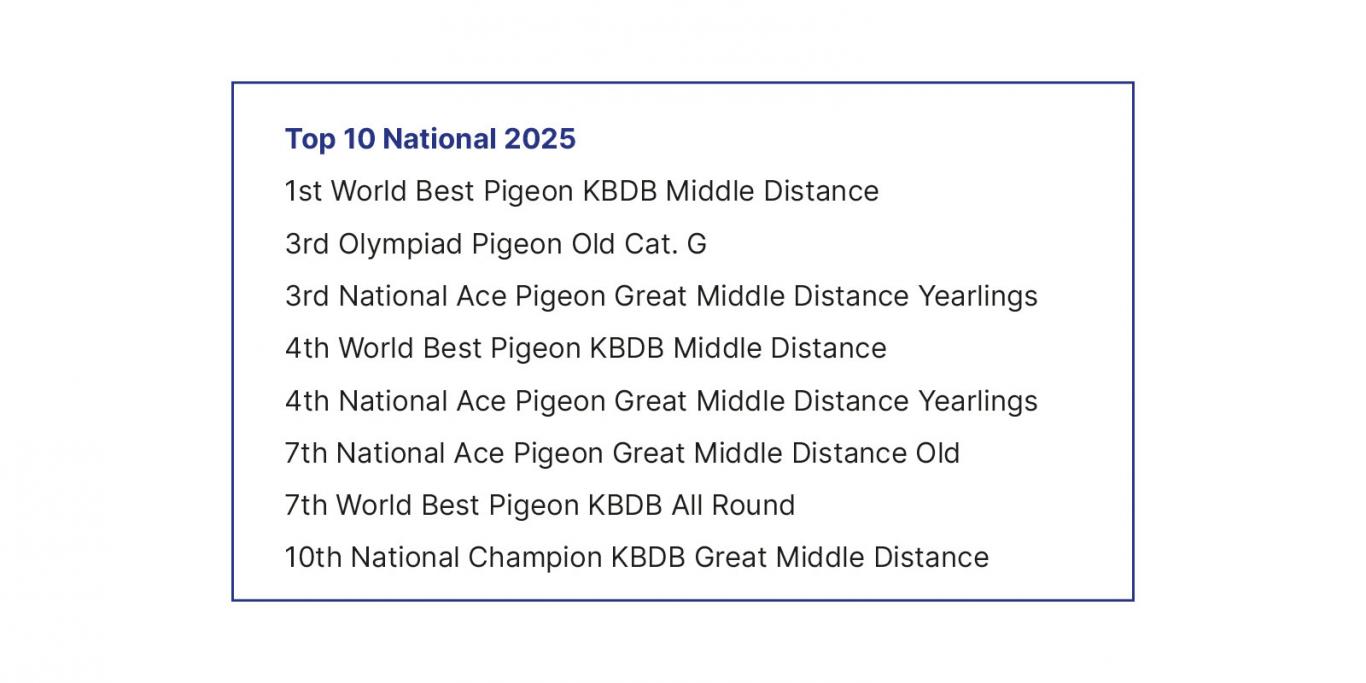
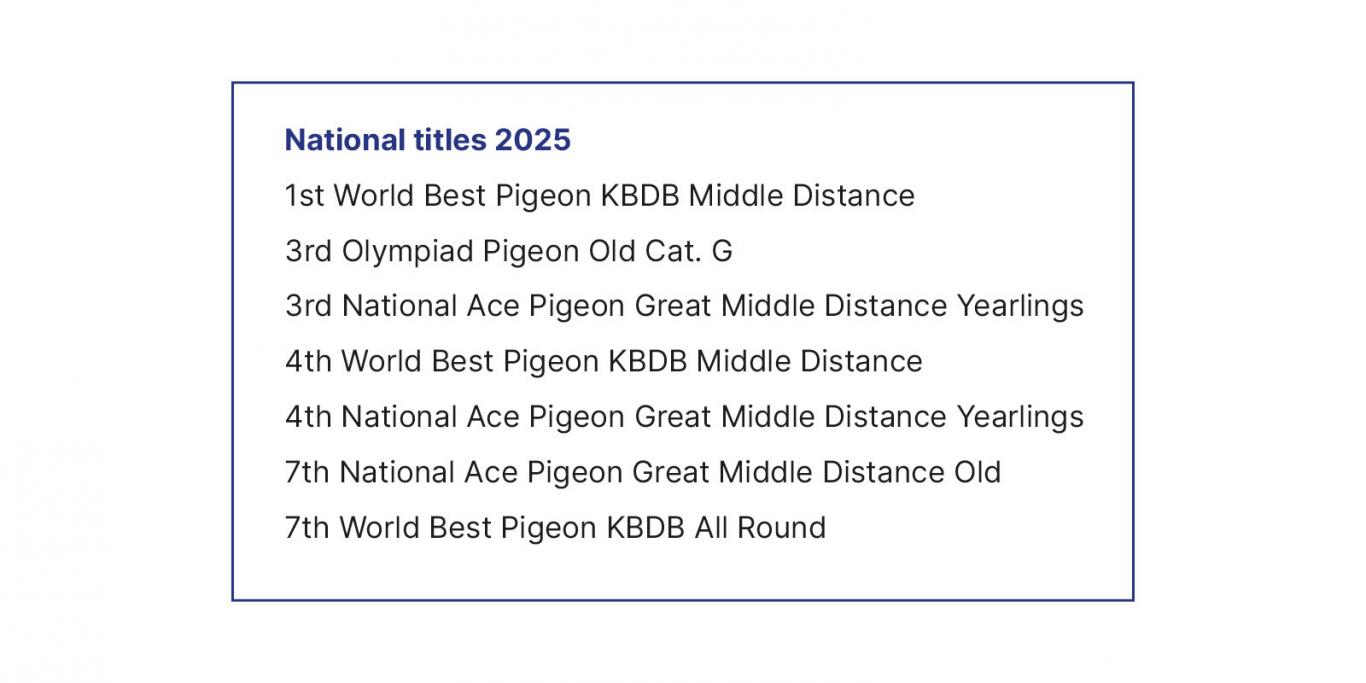
Herbots Bros (Jo and Raf) - 3rd Olympiad Pigeon Old3rd & 4th National Ace Pigeon Great Middle Distance KBDB Yearlings
12 May 2026
3rd Olympiad Pigeon Old
3rd & 4th National Ace Pigeon Great Middle Distance KBDB Yearlings
7th National Ace Pigeon Great Middle Distance KBDB Old
10th National Champion KBDB Great Middle Distance Old
Halle-Booienhoven – The fields around Sint-Truiden are draped in a white, fleece-like blanket of fruit blossoms. The sun is shining, spring is on its way, and nowhere in the country can you feel it better than here. A beautiful spring day, the kind that simply makes you happy.
At the home of Herbots, we were warmly welcomed by the friendly Jo (59). Shortly after, caretaker Geoffrey Janssens (34) joined us, and together with sister Miet they completed our cheerful company. (Raf was excused.) In Halle-Booienhoven, they have every reason to smile. The past season was truly exceptional—a year of abundance.
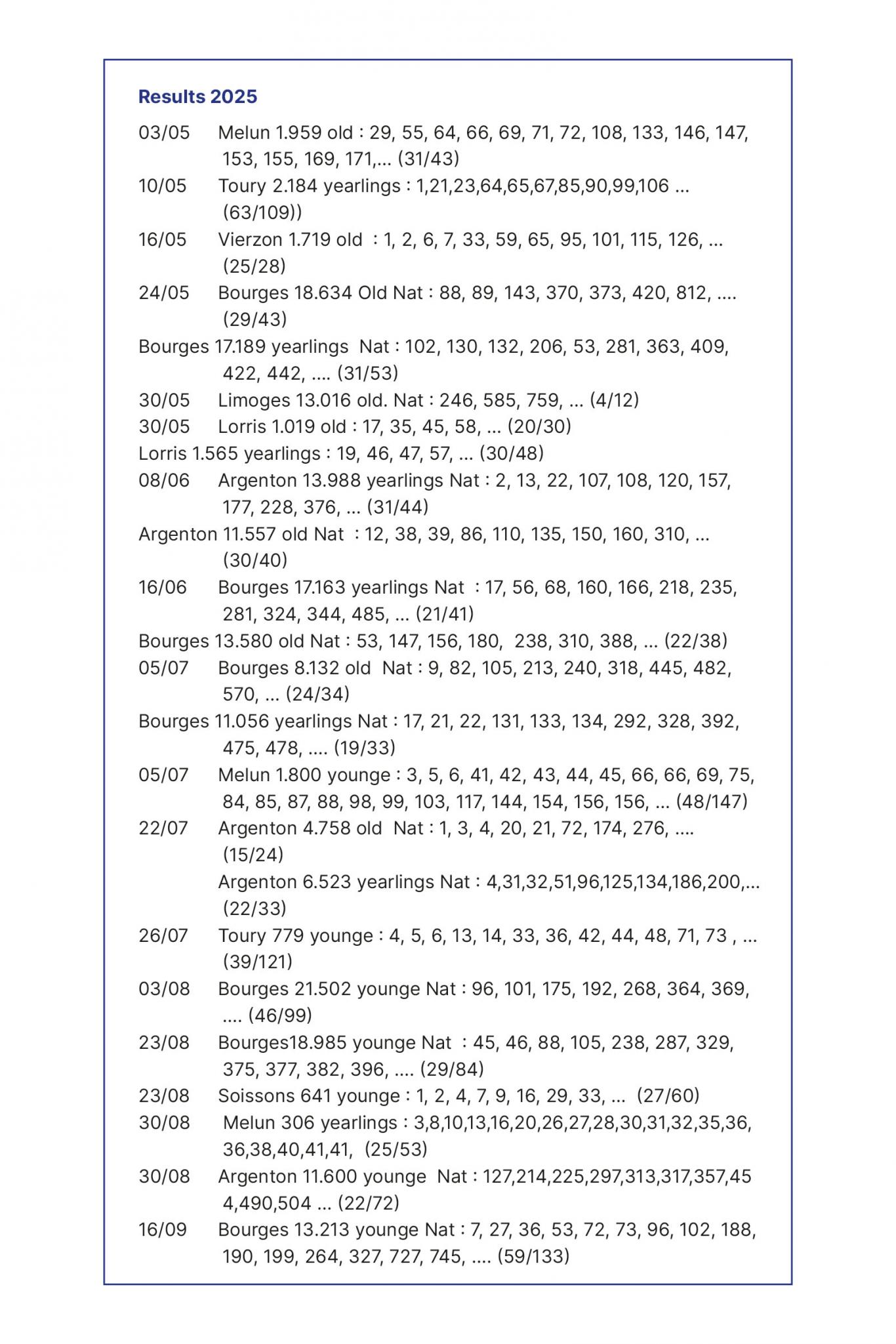
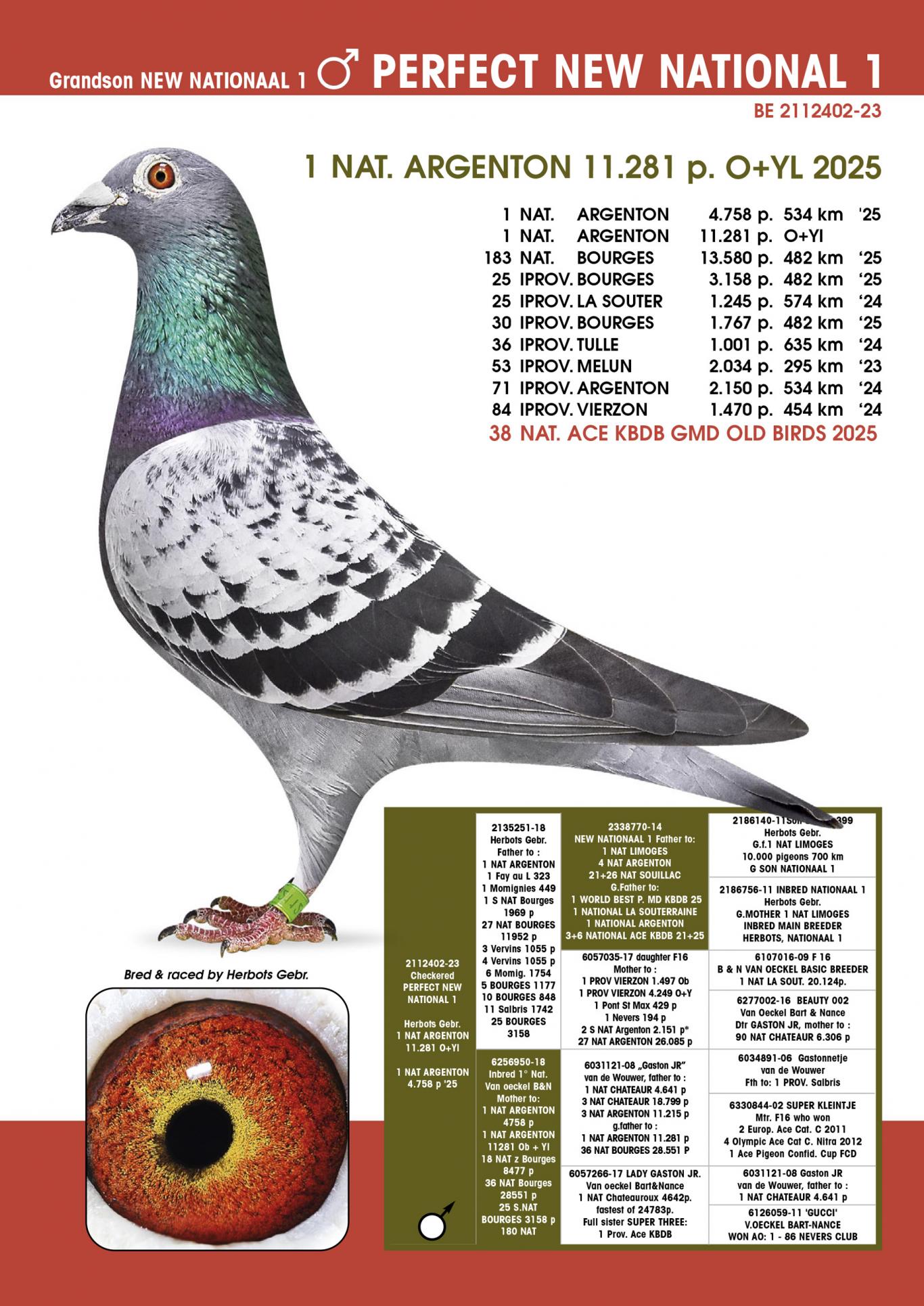
They won 1st National Argenton against 11,281 old/yearlings, and on that same race they also took 3rd and 4th place. Later on, they added 2nd National against 13,988 yearlings and 4th National against 6,523 yearlings at Argenton. Add to that Bourges with 7th National against 13,213 yearlings and 9th National against 8,132 old birds, and you reach a total of 7 national top-10 positions (49 top-100 results).
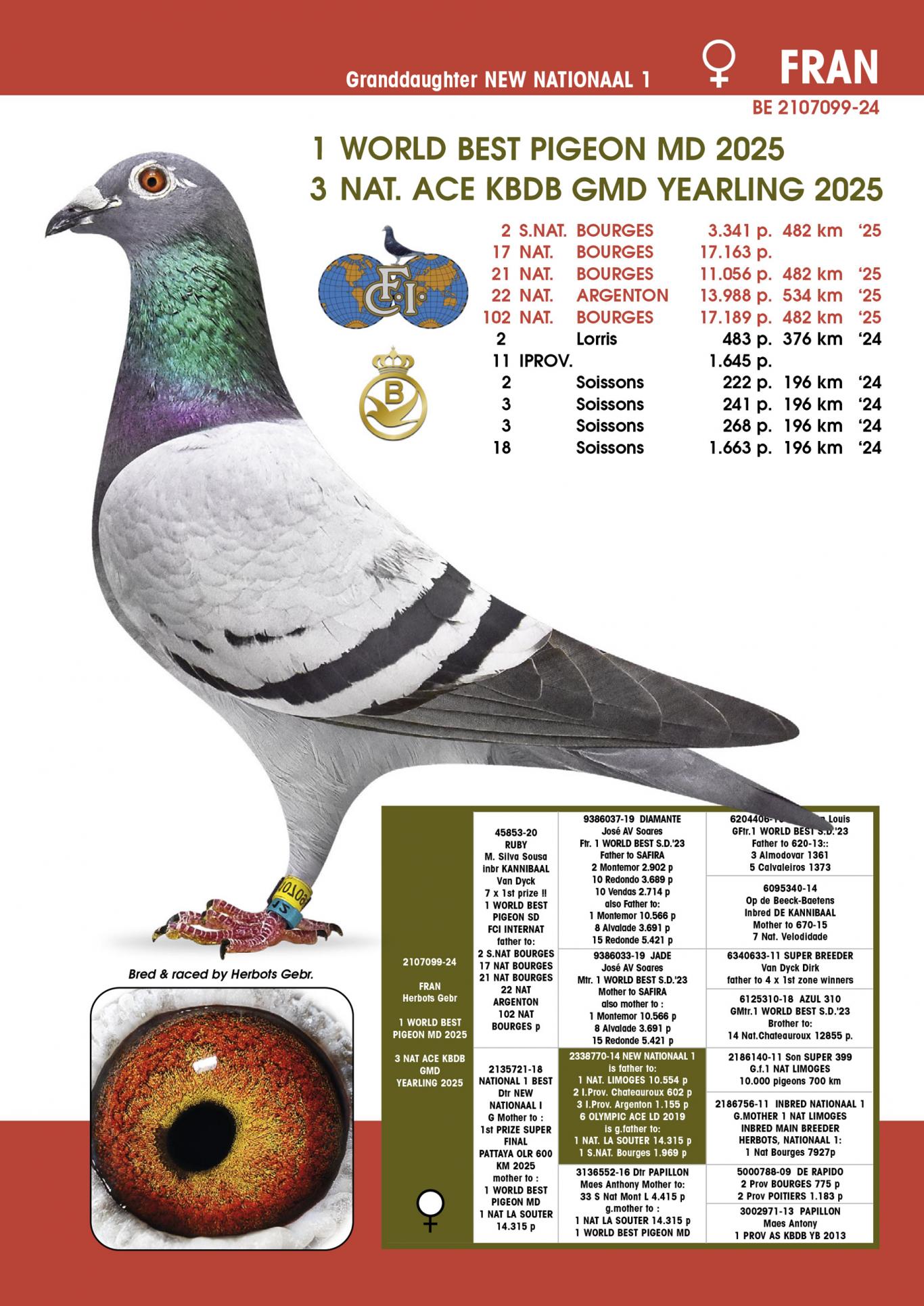
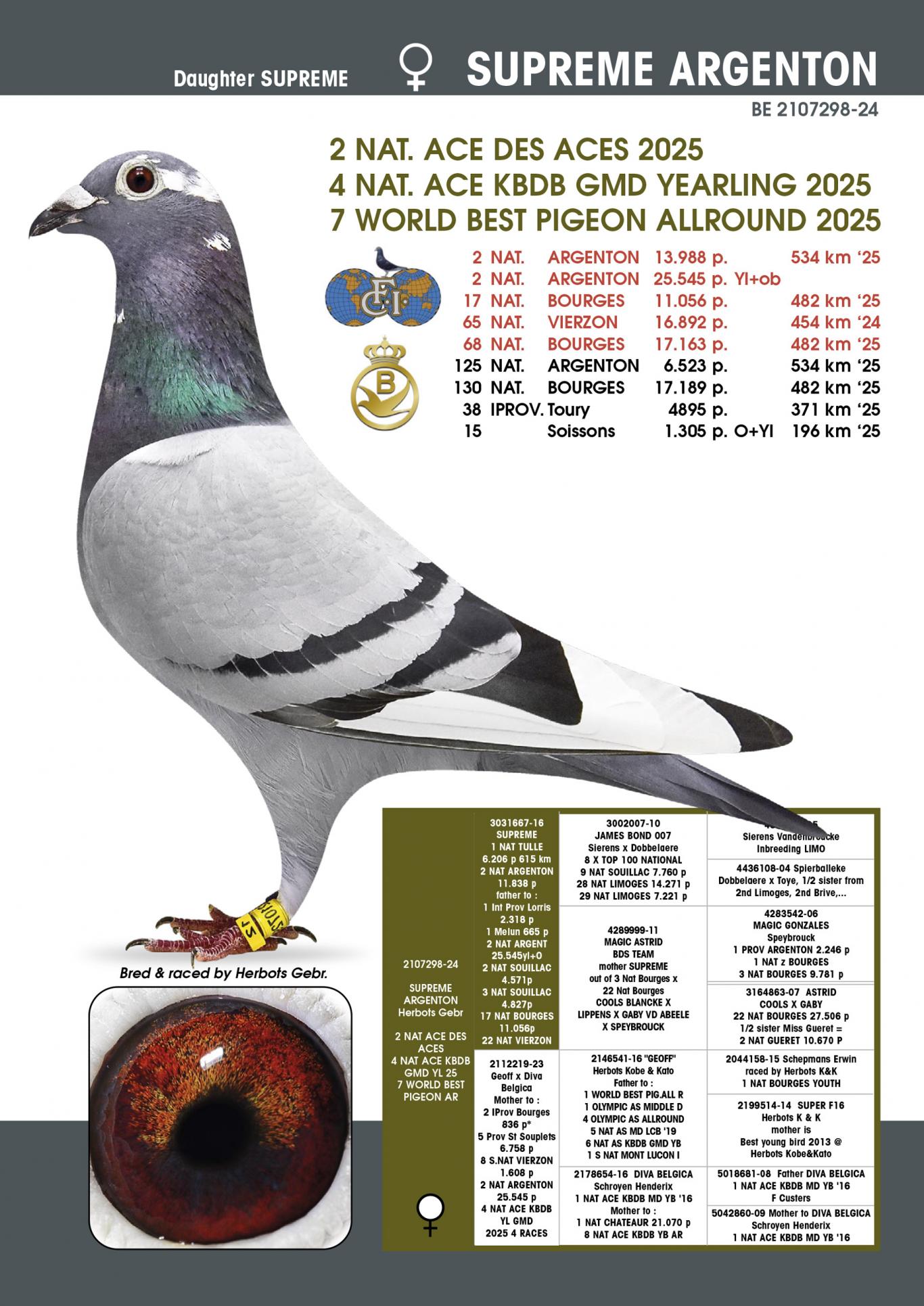
It was a fantastic summer for Team Herbots, and after such a summer, there is plenty to celebrate in winter. In Blankenberge, they stepped onto the podium as 10th National Champion GHF old birds. In addition, several ace pigeons were celebrated. “Fran” (BE24-2107099) became 3rd National Ace Pigeon GHF yearlings (also 1st World Best Pigeon Middle Distance), while “Supreme Argenton” (BE24-2107298) achieved 4th National Ace Pigeon GHF yearlings (7th World Best Pigeon Allround).
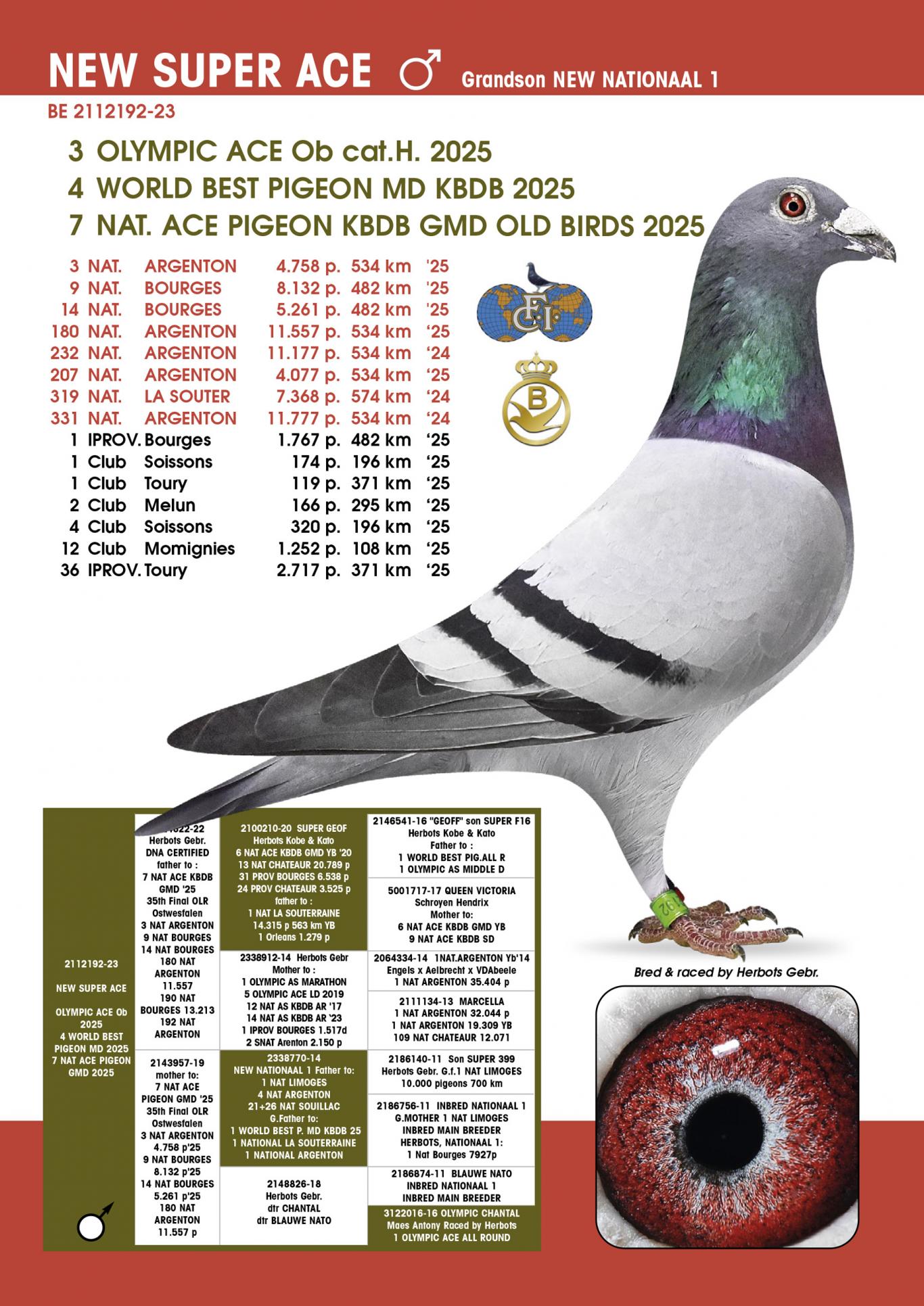
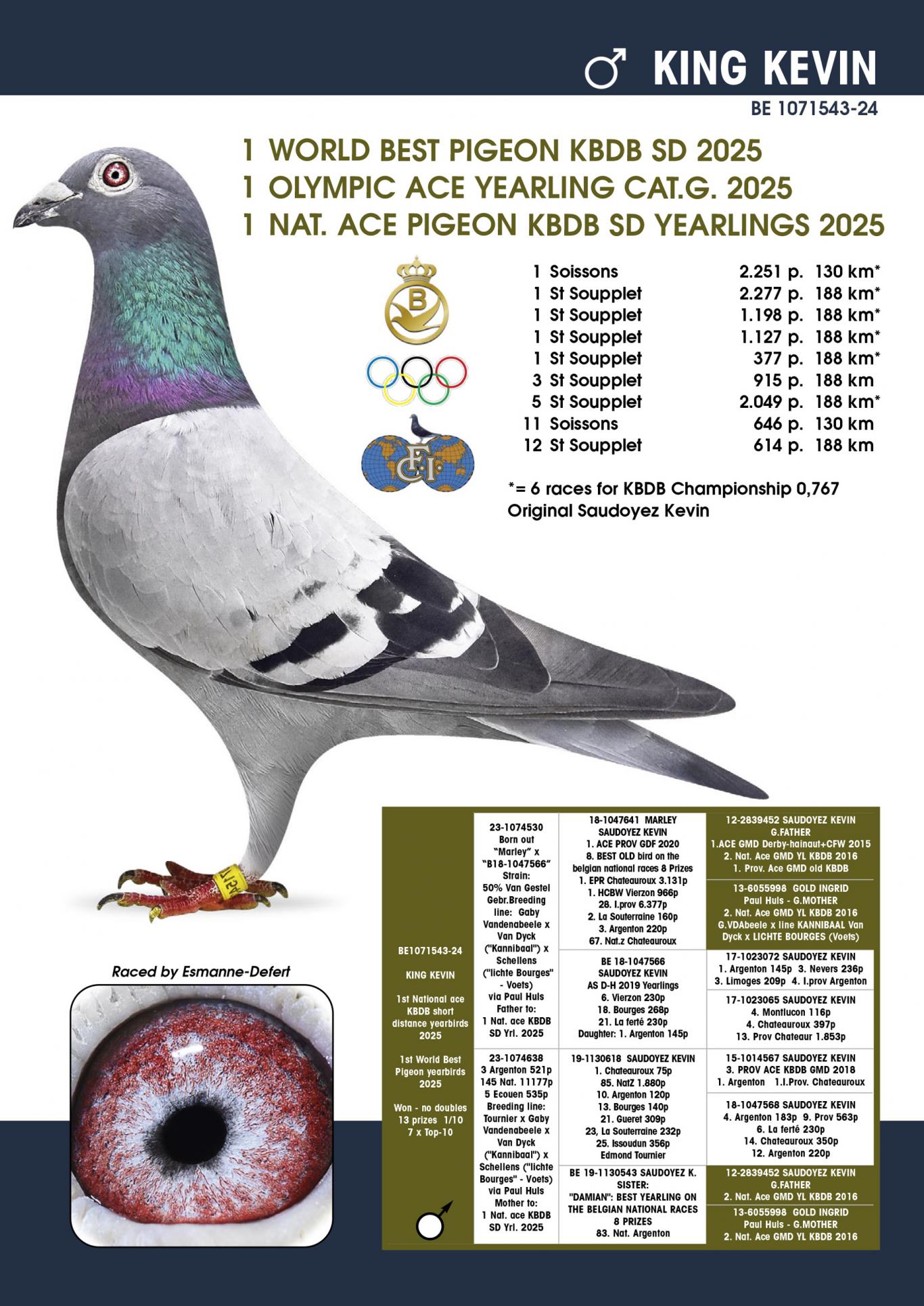
Their trip to Dortmund was also worthwhile. “New Super Ace” (BE23-2112192) was honored there as 3rd Olympiad Pigeon old birds (also 7th National Ace Pigeon GHF old and 4th World Best Pigeon GHF). One is none, they must have thought at Herbots, because they went to Forchies-la-Marche to acquire another top pigeon from the Esmanne-Defert partnership. “King Kevin” (BE24-1071543), 1st Olympiad Pigeon yearlings FCI (also 1st World Best Pigeon FCI yearlings), also moved to the lofts in Halle-Booienhoven.
Earlier, when “King Kevin” had already won 1st National Ace Pigeon KBDB sprint yearlings, Jo had held the pigeon in his hands. Of course, the performances were impressive, but it was especially the feeling the bird gave him that made Jo certain he wanted this pigeon.
Breed as much as possible from the very best you have.
But this winter there was time to celebrate and enjoy the success. Now everything starts again from scratch. Previous results are no guarantee of future success, so it’s back to hard work from here on. Last season started with a racing team of 55 cocks and 65 hens on total widowhood, with about ten hens not paired. By the end, 77 birds remained out of the 120 old/yearlings (mainly losses during races).
Because they had a strong generation last year, the very best we’re all moved to the breeding loft. This season will start with 60 cocks and 65 hens.
Jo: “It was a good racing team, and we have great confidence that they will also perform well as breeders.”
The Olympiad pigeon and the ace pigeons have already been moved to the breeding loft. Four rounds have already been bred from the Olympiad pigeon. This follows the principle of Willem de Bruijn: breed as much as possible from the very best you have.
The racing pigeons were paired around Saint Nicholas, and the breeders a week later, which makes it easier when eggs need to be transferred. The racers are allowed to raise one round of youngsters. In the breeding loft, the 30 boxes are re-paired every three weeks, with eggs always fostered under feeder pairs. In total, around 250 youngsters are bred to be raced.
Regularity in everything
During the winter, everything stays indoors. Normally they are let out earlier, but due to work in the garden, this only started at the beginning of February this year.
Jo: “We were actually planning to completely demolish that loft and build a new one, as it is now 70 years old. Tom Cartuyvels (Kerkom) once came by with his dowsing rod and told us we should not tear it down because it is located in a truly perfect spot. So we decided to keep it and fully renovate it.”
Before the first Momignies race, the pigeons are trained nine times by car (12-12-22-22-32-32-47-65-32-32 km). The youngsters are trained a bit more. During the season, the old/yearlings are only taken by car when they feel it’s necessary because the pigeons are not returning well. The youngsters, in principle, go into the basket on Wednesday—the day before basketing—for a 25 km training toss.
At home, training starts from the end of April, twice a day. Geoffrey keeps them flying. Especially at the beginning of the season, it is important that they train intensively for 90–120 minutes, as they need to build up their base condition for the rest of the season. Evening training for the cocks is different, however—they are not required to do much and often fly only about half an hour.
Before basketing, they are brought together from 11:00 to 12:30, later in the season until 14:00. After that, they are separated, given a bath, fed, and then basketed.
“Regularity in everything” is the motto at the Herbots home. Training, feeding, basketing… everything is done according to a strict schedule.
Jo: “We indeed find that very important. First of all, it would simply not be practical otherwise given the number of pigeons that need to be cared for here. But we also believe that regularity is best for the pigeons.”
Being able to guide them by feel.
Jo: “In pigeon racing, three factors are decisive: good pigeons, good housing, and good management. The latter means being able to keep the pigeons healthy and bring them into form. An important quality in a caretaker is dedication. That one there (points to Geoffrey) is here even when he doesn’t have to be. But no matter how driven you are, you also need to have it in your fingers. You have to open your eyes, you have to have ‘seen it’, and then be able to guide them by feel. That’s a quality all good fanciers have—that ‘feeling in the fingers’.
That old loft was therefore renovated and also got a new roof. Geoffrey and I entered the new loft and I immediately felt a draft. I mentioned it to Geoffrey, and he had already noticed that when the wind comes from a certain direction, there is a draft in the loft. That’s exactly what I mean! He had observed it and had already noticed it himself. Yes, he’s got it!”
Geoffrey blushes a bit from all the praise coming from his employer.
Geoffrey: “I also read a lot, look things up, and exchange ideas with colleagues a lot—also with the colleagues here. I may have the final responsibility for the racing team, but that doesn’t mean I’m always right. Everyone knows something, you can learn something from everyone, and you can take something from every situation. Two years ago was a difficult season. On a very bad race from Melun, they broke down, and the season never really recovered. But we learned from that.”
Jo: “Giving a bit of extra motivation at the right moment is also very important. But then again, that brings us back to the fact that it’s something a good fancier can see.”
Geoffrey: “That Olympiad pigeon still needed one good result to secure its title. I gave him a box. He would sit on it a bit, but because it was turned the wrong way, he couldn’t get into it. So I first turned the box around, and then he went inside. After that, I removed the box and only put it back on Thursday before basketing. I first let another cock near the box to make him jealous, and only then did I let him in. He quickly asserted himself and climbed into ‘his’ box. On that race, he earned his title.”
Feeding and medical care
The medical care is, of course, in the hands of Raf (57) and his son Kobe (28), who has also become a veterinarian and opened his own practice in Chapelle-lez-Herlaimont.
After the season, the old pigeons receive a 10-day paratyphoid treatment, followed by 5 days of Herbochol in the water. Afterwards, they are vaccinated against paratyphoid. At the end of October, a 2-day deworming treatment is given. Around Saint Nicholas, the racing pigeons are paired, and once they have been sitting on eggs for a few days, they are vaccinated against paramyxovirus with Colombovac PMV and receive a 7-day treatment against trichomoniasis via the drinking water.
Once the youngsters are weaned, they again receive a 10-day paratyphoid treatment, followed by a few days of Herbochol and then another vaccination against paratyphoid. Afterwards, a lot of Herbial and Herbochol (from the Herbovet range) is given to purify the pigeons and help them shed their old down. Around mid-March, they are also vaccinated against pox. This is followed by another check-up with Raf and Kobe to rule out any infections or issues.
As soon as the youngsters are weaned, they receive PMV-Rota, which is repeated three weeks later. Two weeks after that, they are vaccinated against pox. Finally, they receive another paratyphoid treatment and are vaccinated against it.
Every two weeks, the pigeons are checked by Raf and Kobe to rule out infections. During the season, no treatments are given blindly; everything is done in consultation with Raf and Kobe. We strongly believe in vaccination to strengthen immunity, making us far less dependent on medication.
Products frequently used include Herbial in spring to cleanse the pigeons. During the season, liters of ALR are given—an all-round product that promotes condition building and speeds up recovery.
Each week, Optimix/Prodigist with 4 oils and Herbo Elite Pigeon are added to the feed. In addition, Herbo CMB Plus and Herbo Ma Liquid (from the Herbovet range) are regularly used, as well as Aminovit from the Herbots range.
In autumn, a 4-week system is applied, alternating between four different products: Bronchofit (a liquid oregano tea), Herbochol to support the liver, Herbo Aqua Control to acidify the water, and Vita Duif. This system is also used at the start with the young pigeons.
Nutrition is, of course, also a very important factor. Mixtures from different brands are used, and everything is again done according to a strict schedule.
Upon returning home, the pigeons are brought together and a detox mineral mix is waiting for them. (After returning from a race, they receive yellow drops in the nose.) Once separated, they are given a “buffet” of 1/3 breeding mix, 1/3 sport mix, and 1/3 fat-rich mix (in a 1-meter-long feeder, 33 cm of each type). This remains available until Sunday morning. On Sunday evening, they receive another detox mix. From Monday onward, the hens receive ½ light and ½ sport mix. The cocks receive ½ sport and ½ fat-rich mix from Monday until basketing, as cocks naturally consume more energy.
This brings us to the idea that cocks would not be able to race every week. Both gentlemen consider this nonsense. As with everything in pigeon racing, it is a matter of selection.
Jo: “Pigeons that are in the right condition can do it.”
Geoffrey: “Since we’re talking about what they supposedly can’t handle—this decision by the KBDB to only allow basketing every two weeks will, in my opinion, actually cause more losses. Once you’ve chosen the first race, you can hardly choose anymore—you have to basket, even if it’s going to be tough and everything is against you. You want to be able to basket when conditions are good and your pigeons are in form. In my view, that’s also in the best interest of the pigeons.”
Once we start discussing KBDB decisions, there’s no stopping—it could go on for hours. But it’s time for us to head home. Before we leave, Jo has one more message.
Jo: “During this conversation I’ve praised Geoffrey quite a lot—and rightly so. Still, I want to emphasize that we are a team and that everyone is important within it. Geoffrey is responsible for the racing team. Then there is Björn Knaepen (34), who mainly takes care of the breeders. Kevin Roosen (35) and Jeroen Stroobants (40) handle the pigeons for trade (both online and offline sales) and also assist with the breeding loft. Everyone has their own role, but they also jump in everywhere to help each other. There is also Jo Van Haelst (61, Miet’s husband). One of his many tasks is helping with basketing, and he also drives during training tosses.
The pairing of the pigeons is done by Jo, always in consultation with the caretakers. He also helps at every race with catching the pigeons for basketing. Manager or not, Jo remains, above all, a pigeon fancier. And it couldn’t be otherwise—in the Herbots family, they were all born and raised in a true pigeon nest.”
Mike Verbruggen – De Duif