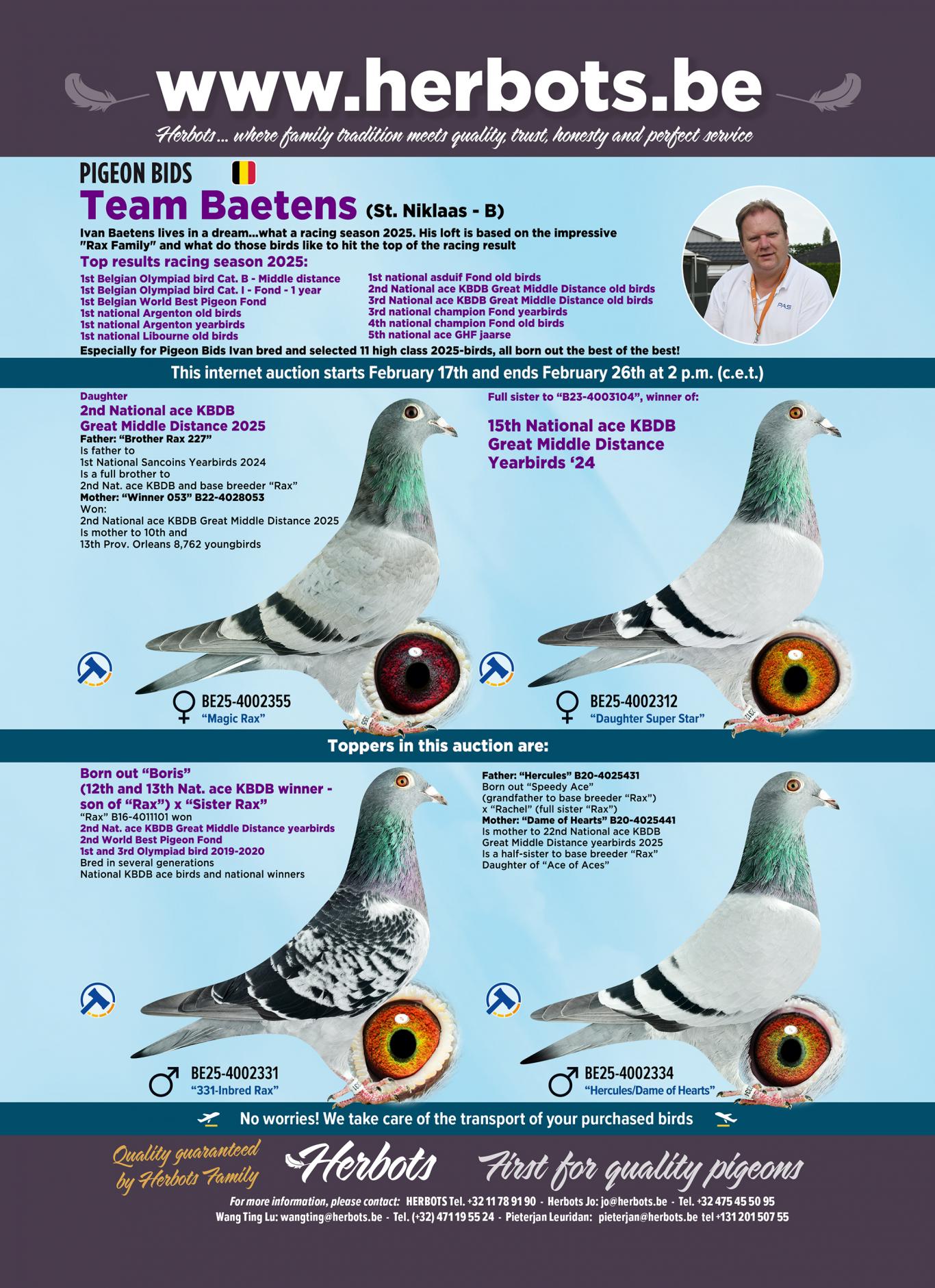
Team Baetens (Temse) is still pinching themselves... what a dream season 2025 has been.
23 Feb 2026
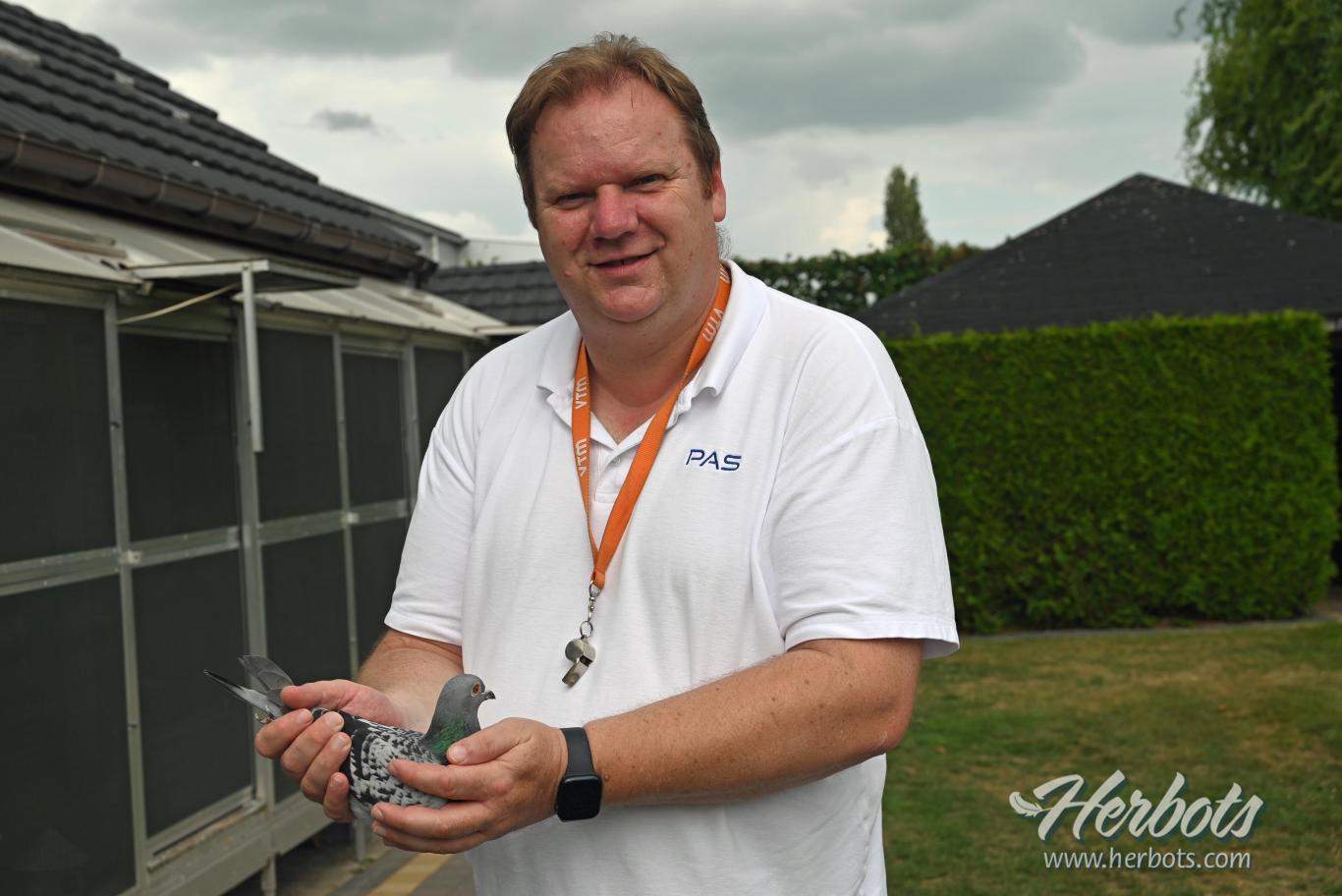
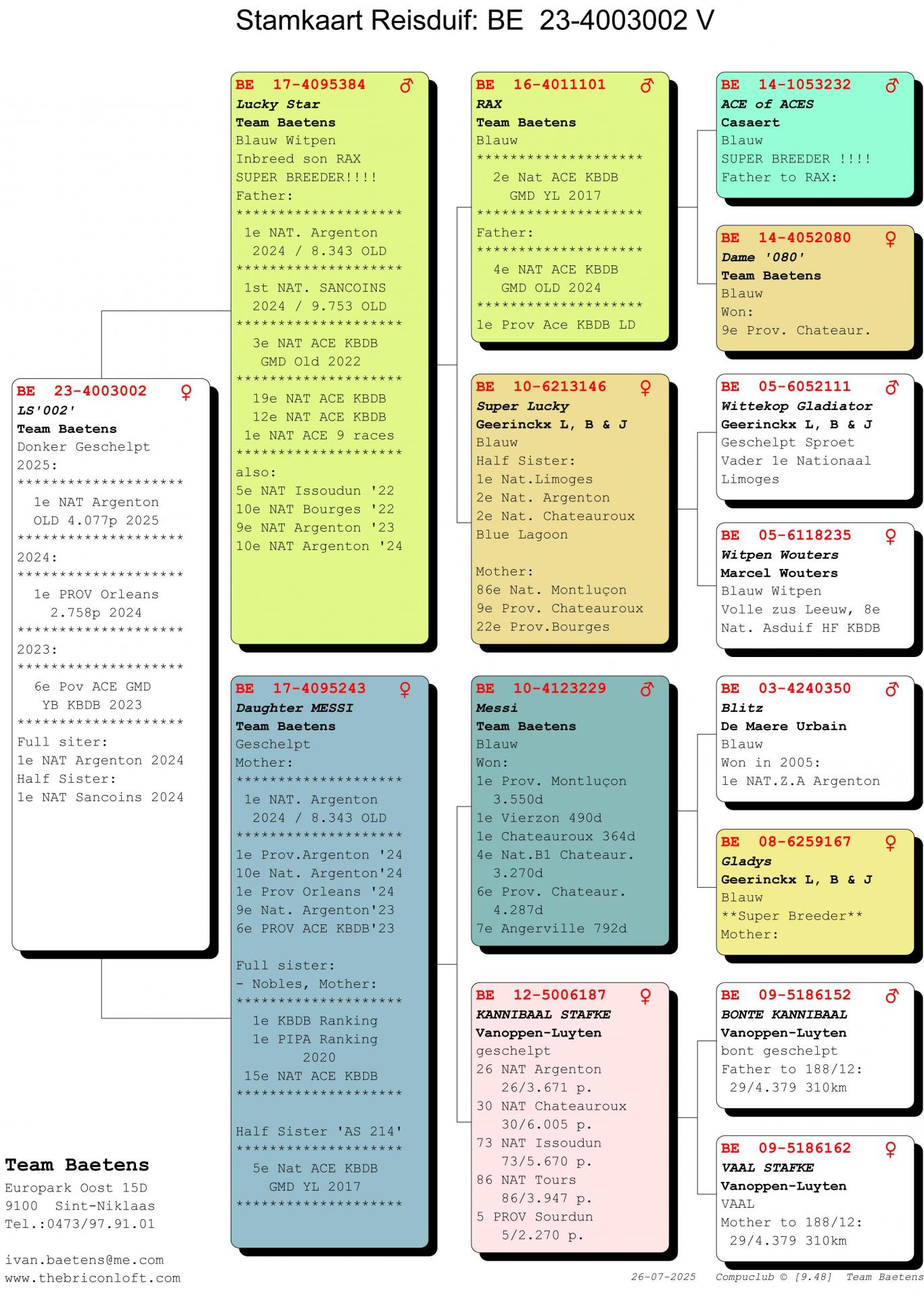
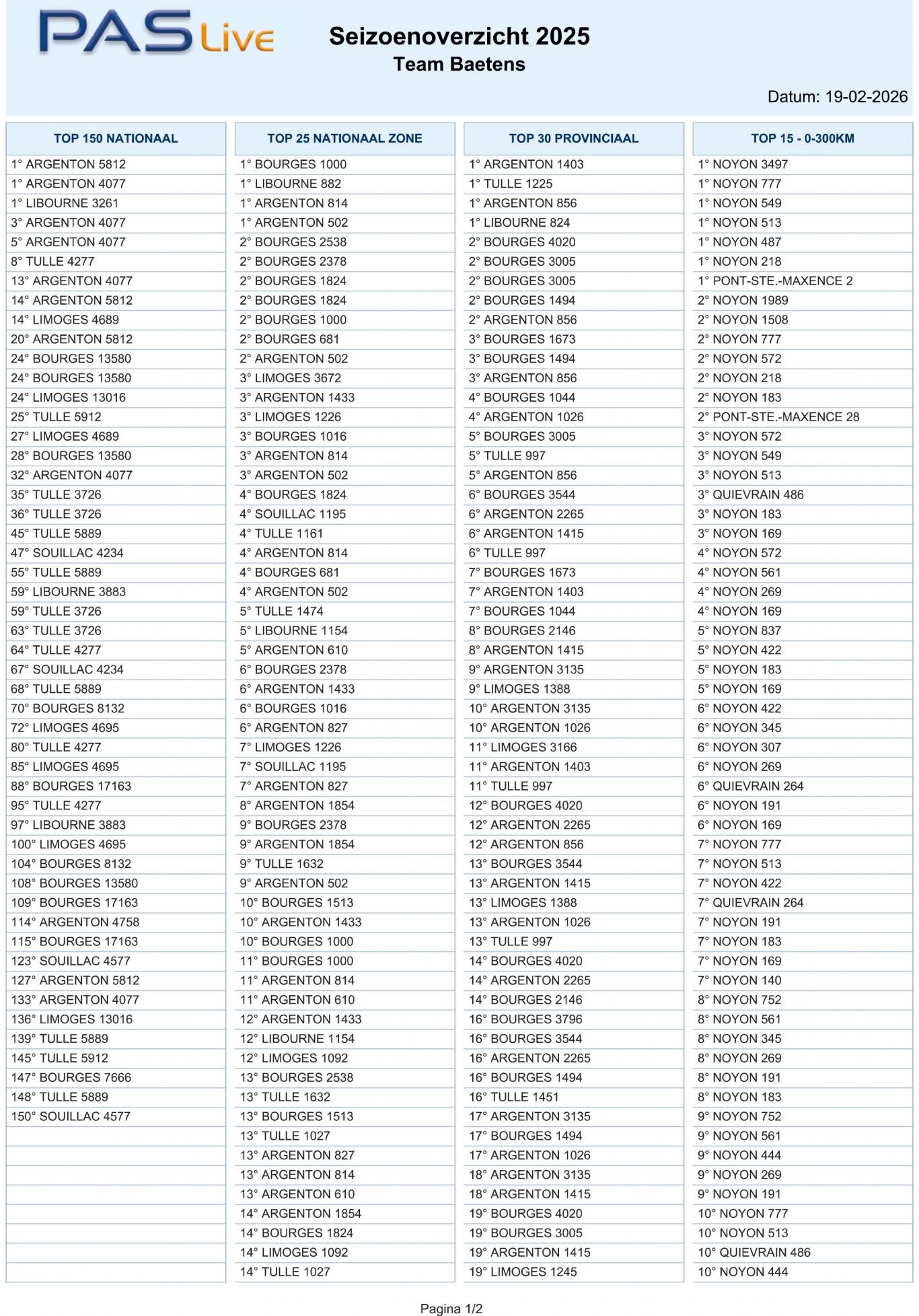
A unique achievement in the history of Belgian pigeon racing... winning 3 national victories in 2 different races in the same weekend! As far as we know, this has never happened before. This unique achievement was achieved by Team Baetens, or Ivan Baetens, from Sint Niklaas in East Flanders. In the 2024 season, Ivan also won 1st National Sancoins against 9,749 old birds with "Miss Sancoins," and on the same race, he also won 1st National against 12,962 yearlings (fastest of 22,711 p.) with "De Super." A few weeks later, Ivan also added 1st National Argenton against 8,343 old birds with "Miss Argenton" to his list of achievements. Well... the same weekend that "Miss Argenton" was lauded for her national victory, her sister "LS 002" (B23-4003002) won 1st provincial prize Orleans against 2,758 old pigeons. At the end of the 2024 season, "LS 002" finished 6th provincial ace pigeon KBDB East Flanders. Now, a year later – the 2025 season – "LS 002" wins 1st national Argenton against 4,077 old pigeons and was the fastest of the entire release of 9,889 pigeons (1357 m/m – 541 km). How beautiful pigeon racing can be... two sisters each winning a 1st national Argenton. And to further underscore the class of the Baetens pigeons, both "Miss Argenton" and "LS 002" are also half-sisters, with the same sire, of the 1st National Sancoins!
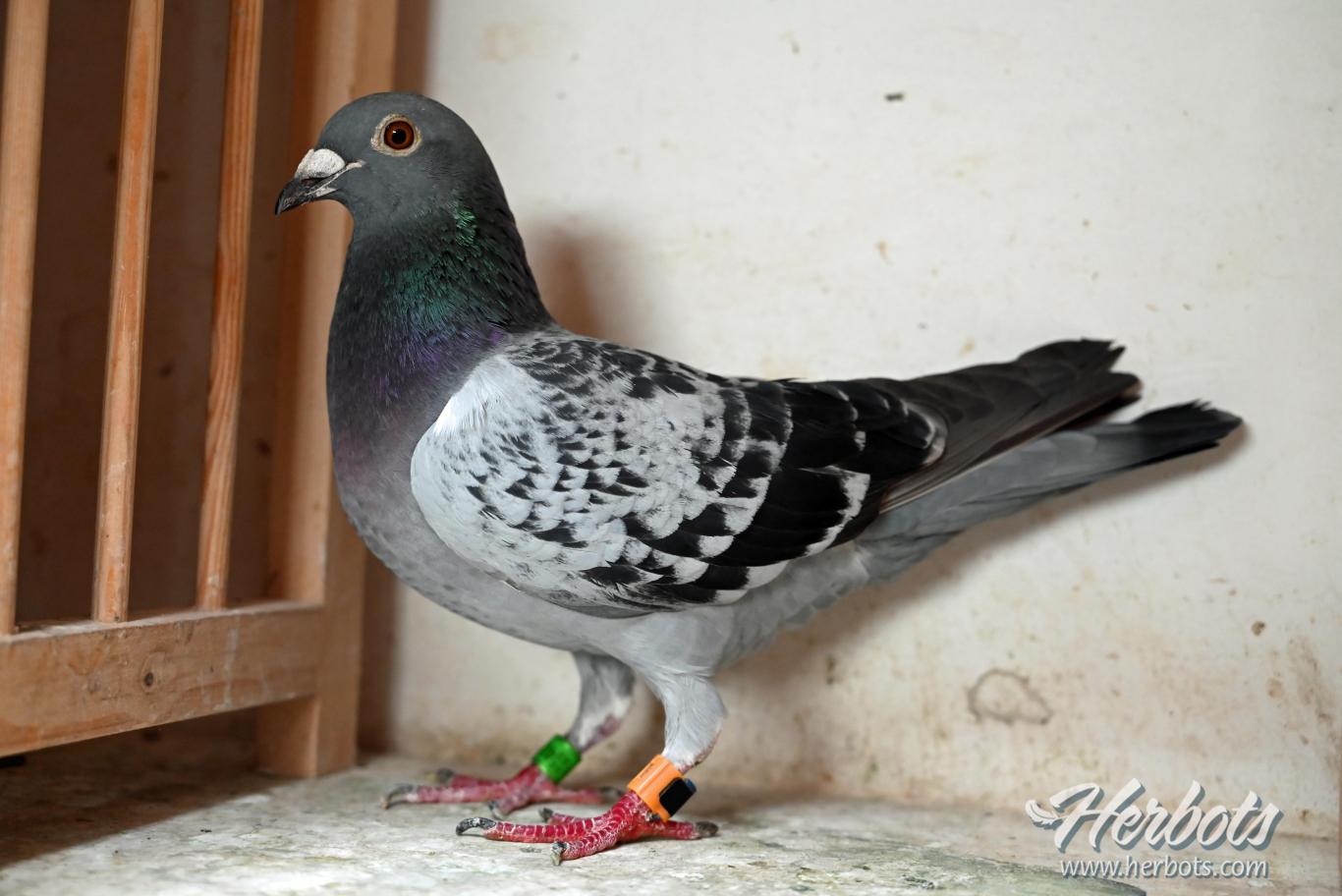
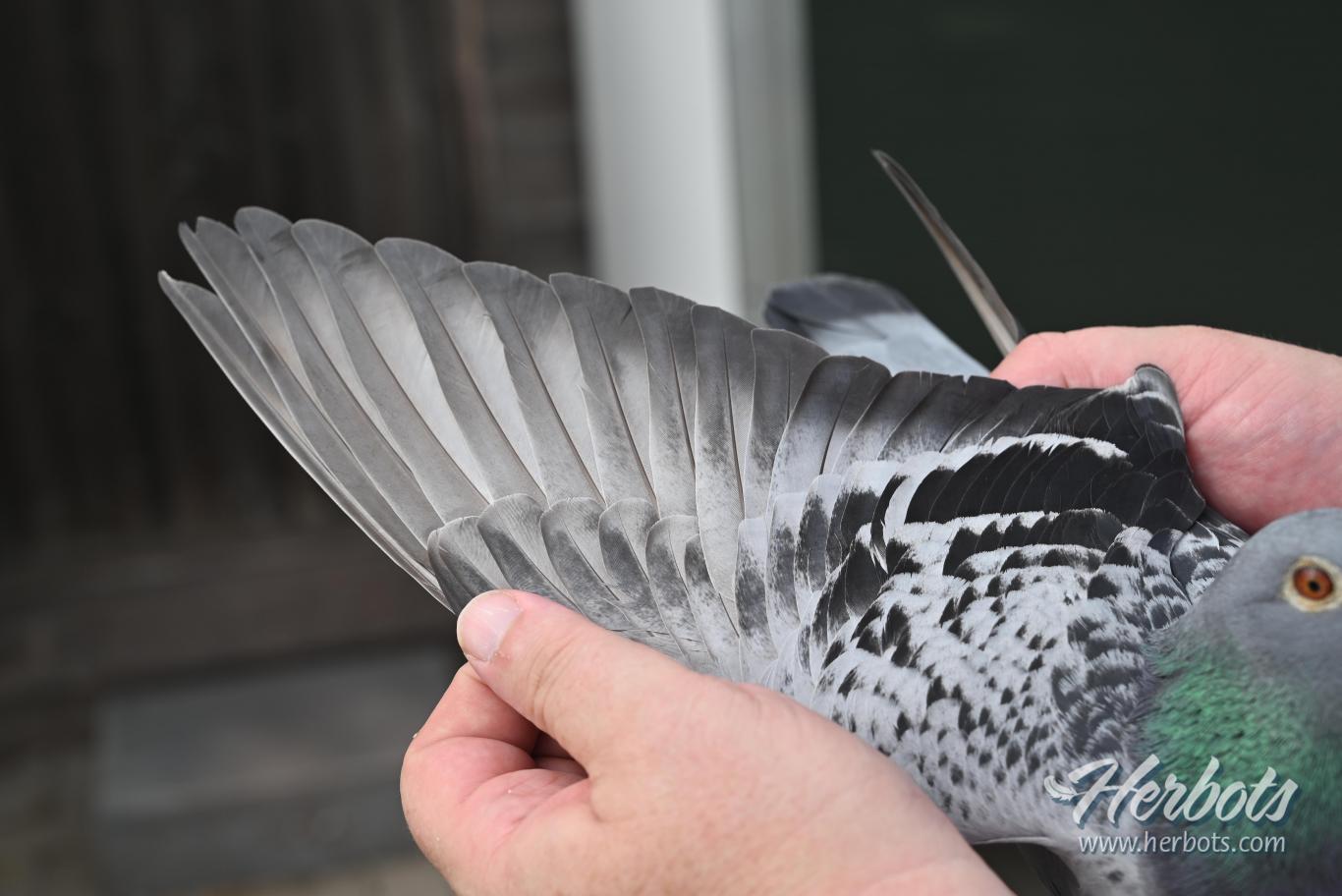
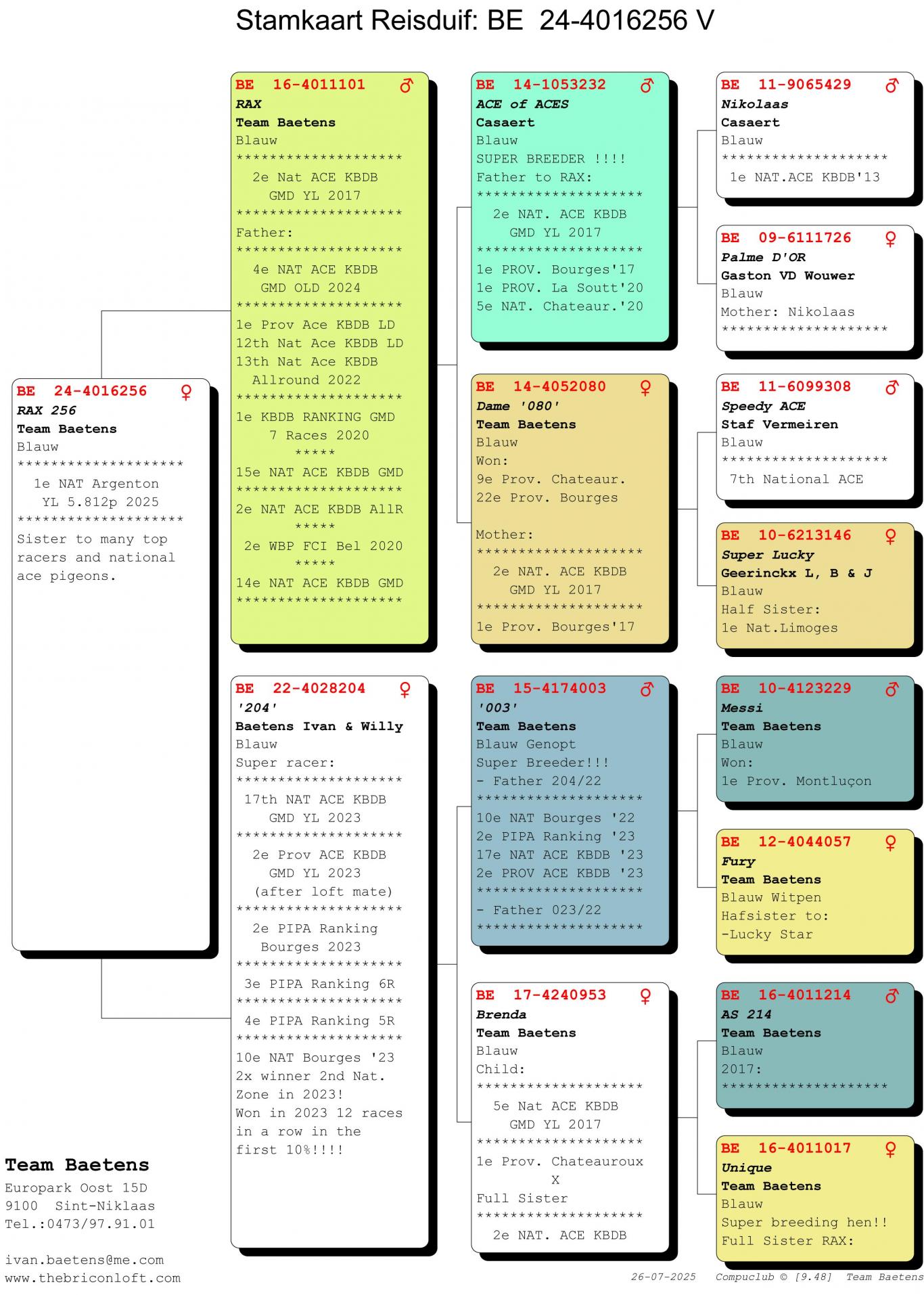
Let's go back to that famous Argenton race of July 26, 2025. A good 2 minutes and 30 seconds after "LS 002," the Pas system beeped again in the air of Sint-Niklaas. It was "Rax 256" (B24-4016256) who had registered, and the Baetens household was completely blown away when they saw that "Rax 256" had won 1st National Argenton (1348 m/m) in her category against 5,812 yearlings. Just like in the 2024 season from Sancoins, Ivan now wins two more 1st Nationals from Argenton. Incidentally, "Rax 256" is the youngest daughter of stock sire "Rax" who was still raced.
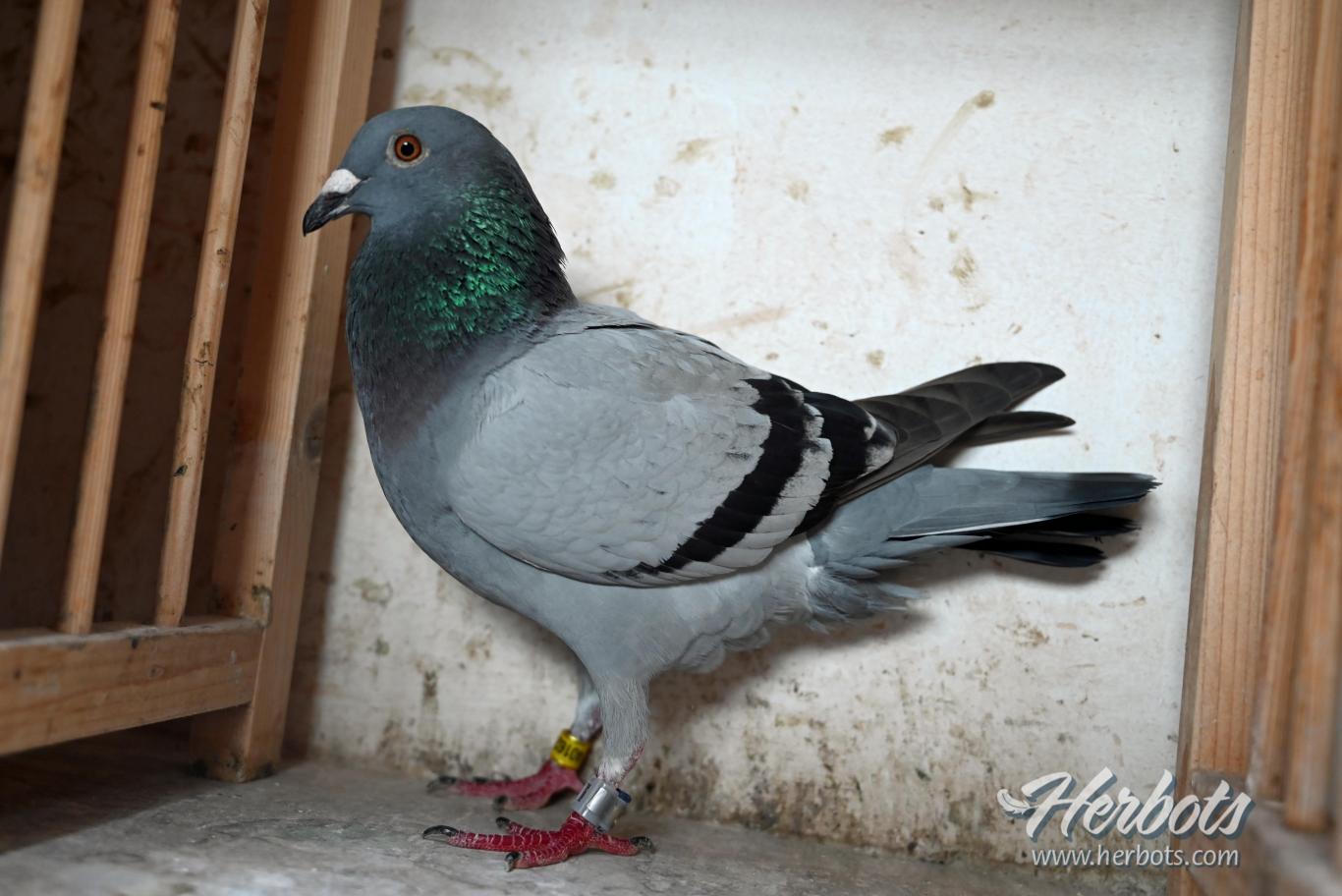
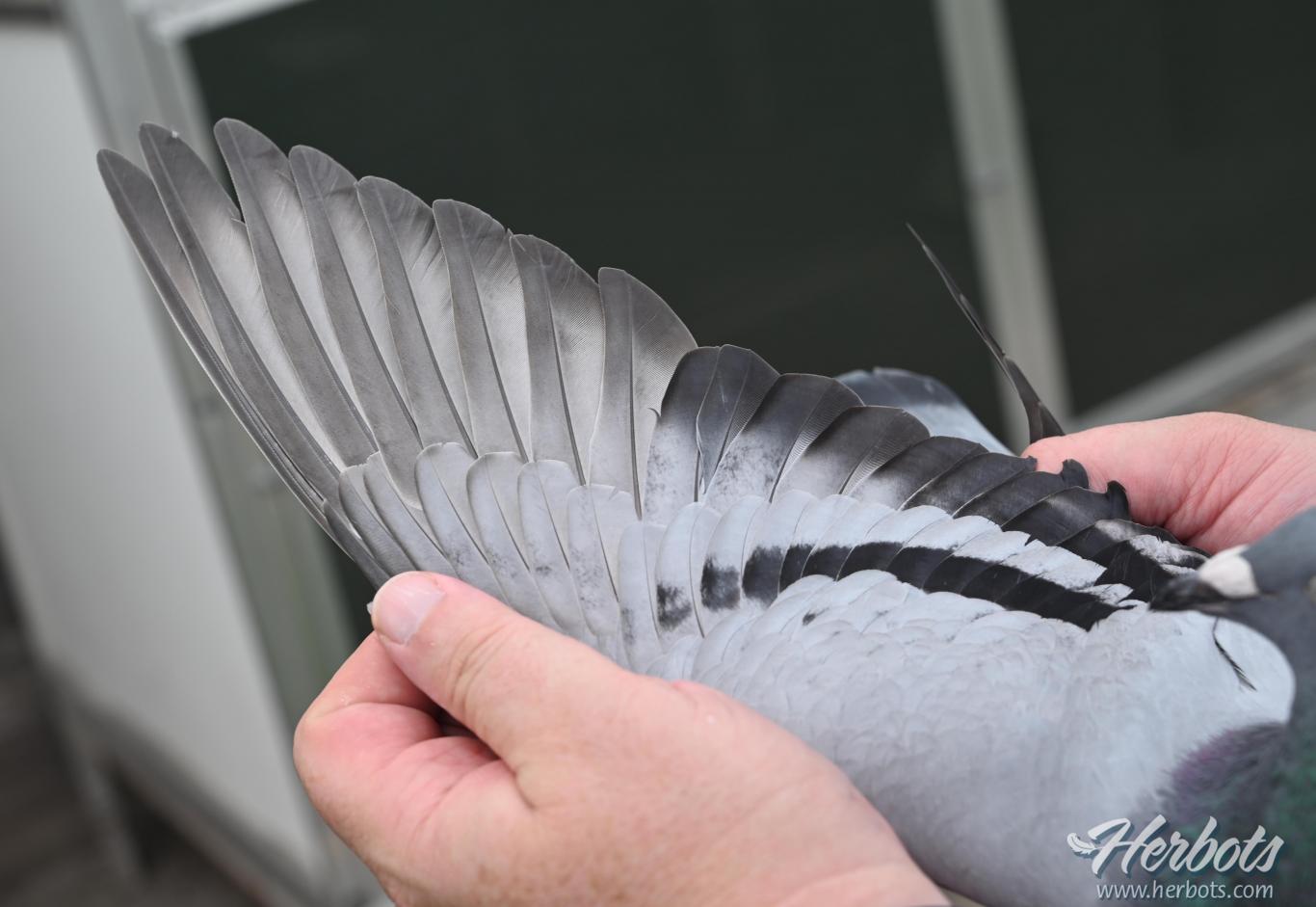
Her form was clearly evident in the impressive loft setup, as the Argenton result deserves to be framed and hung in the Bricon office:
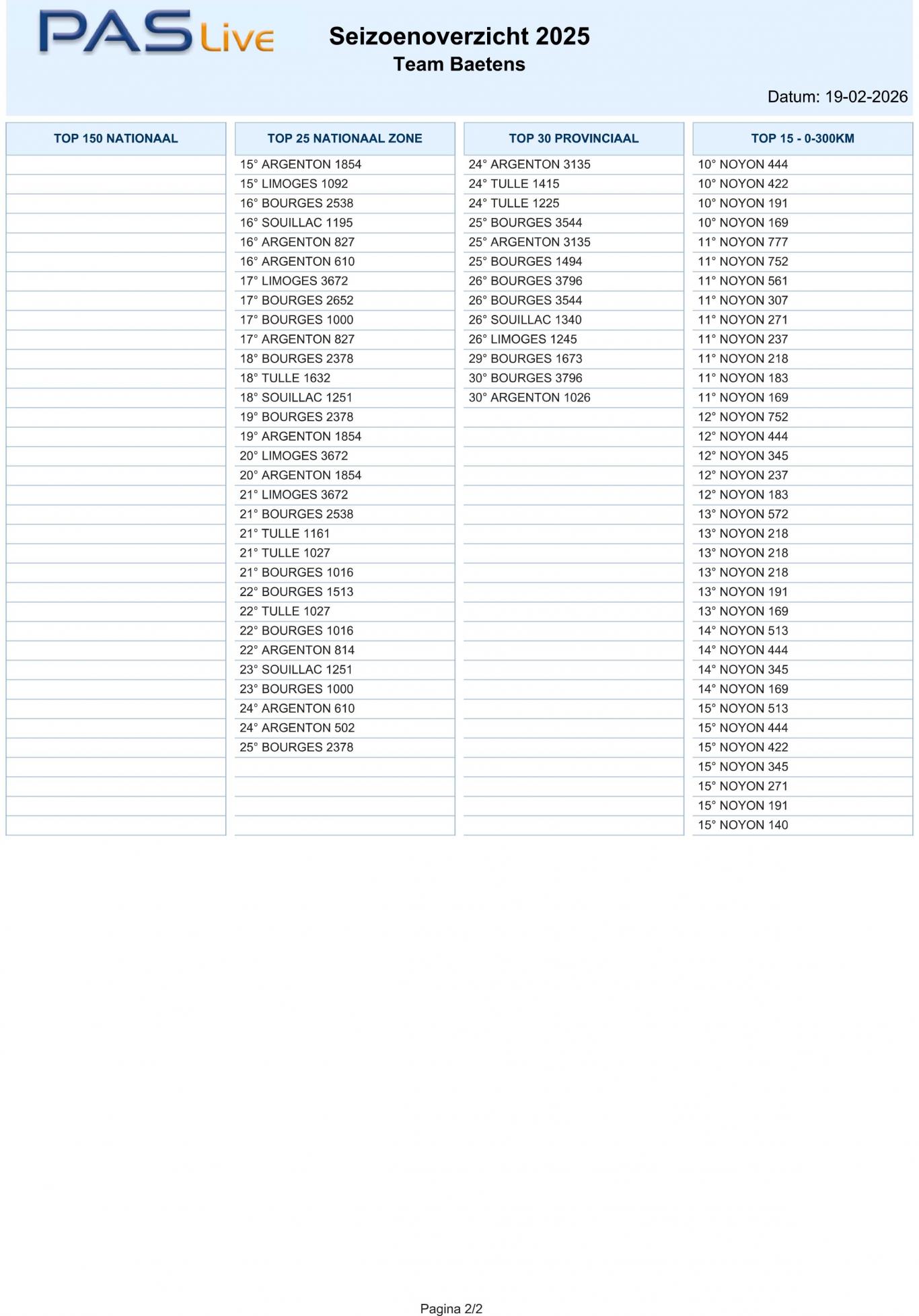
Argenton national 4,077 old birds: 1-3-5-13-32-133-178-250-267-351 (10/10)
Argenton national 5,812 yearlings: 1-14-20-127-155-245-380-471 (12/14)
We still remember well when we were with Ivan photographing the national Argenton winners for the report on the Herbots website, and he looked a bit nervous. "The pigeons from Libourne will soon be storming the country," he began his story, "and with 'Riva,' I've brought a candidate for national ace pigeon KBDB Long Distance. Hopefully, she's also in top form and can rank among the top national results." Onde
Ivan's wish more than came true, as his hen "Riva" (B23-4003301) won more than just a national top prize; she took the top prize and had her ring number recorded at the top of the results. There's now a very real chance she'll win the title of 1st national ace pigeon KBDB Long Distance old birds.
Libourne national 3,261 old birds: 1-345-510 (3/3)
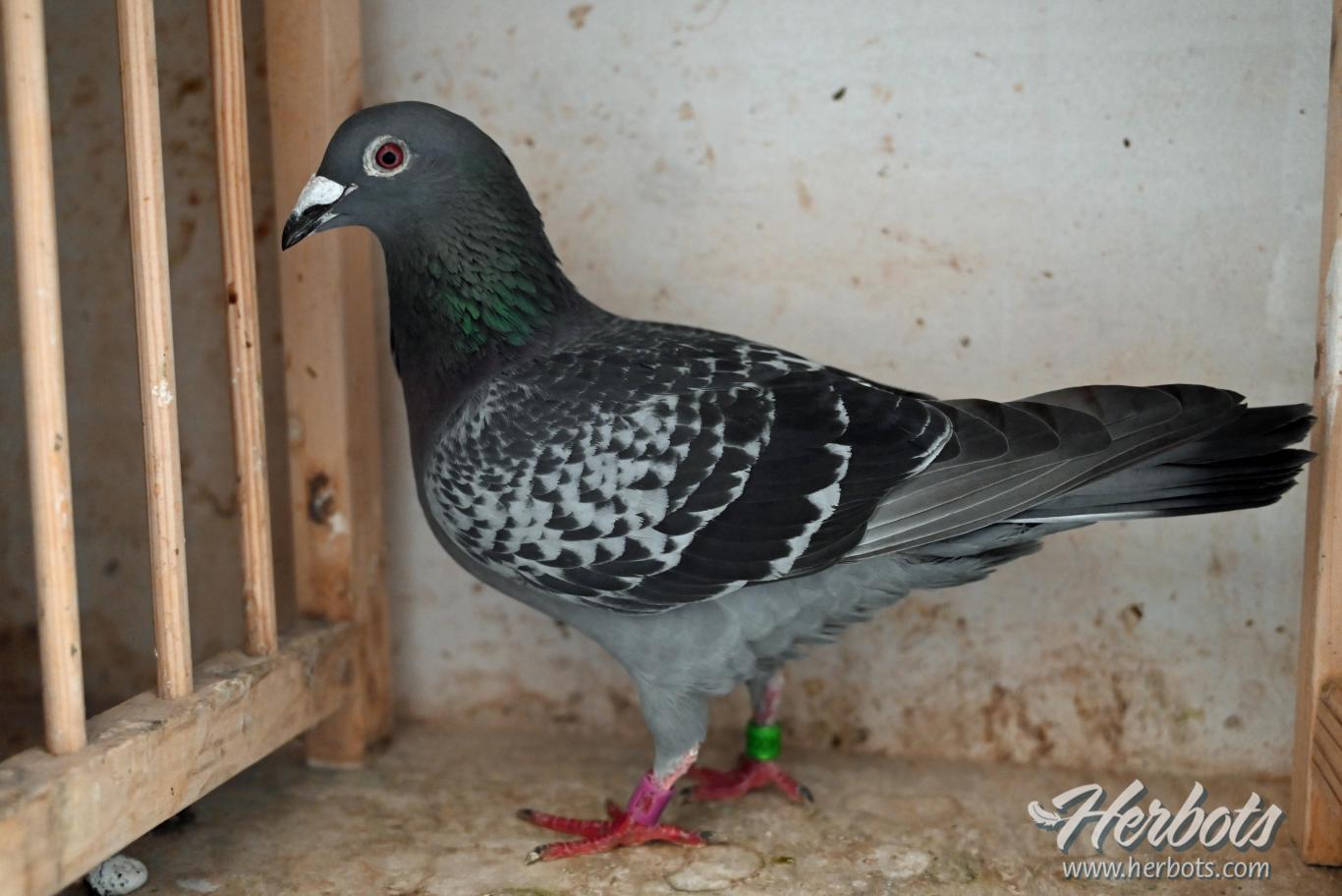
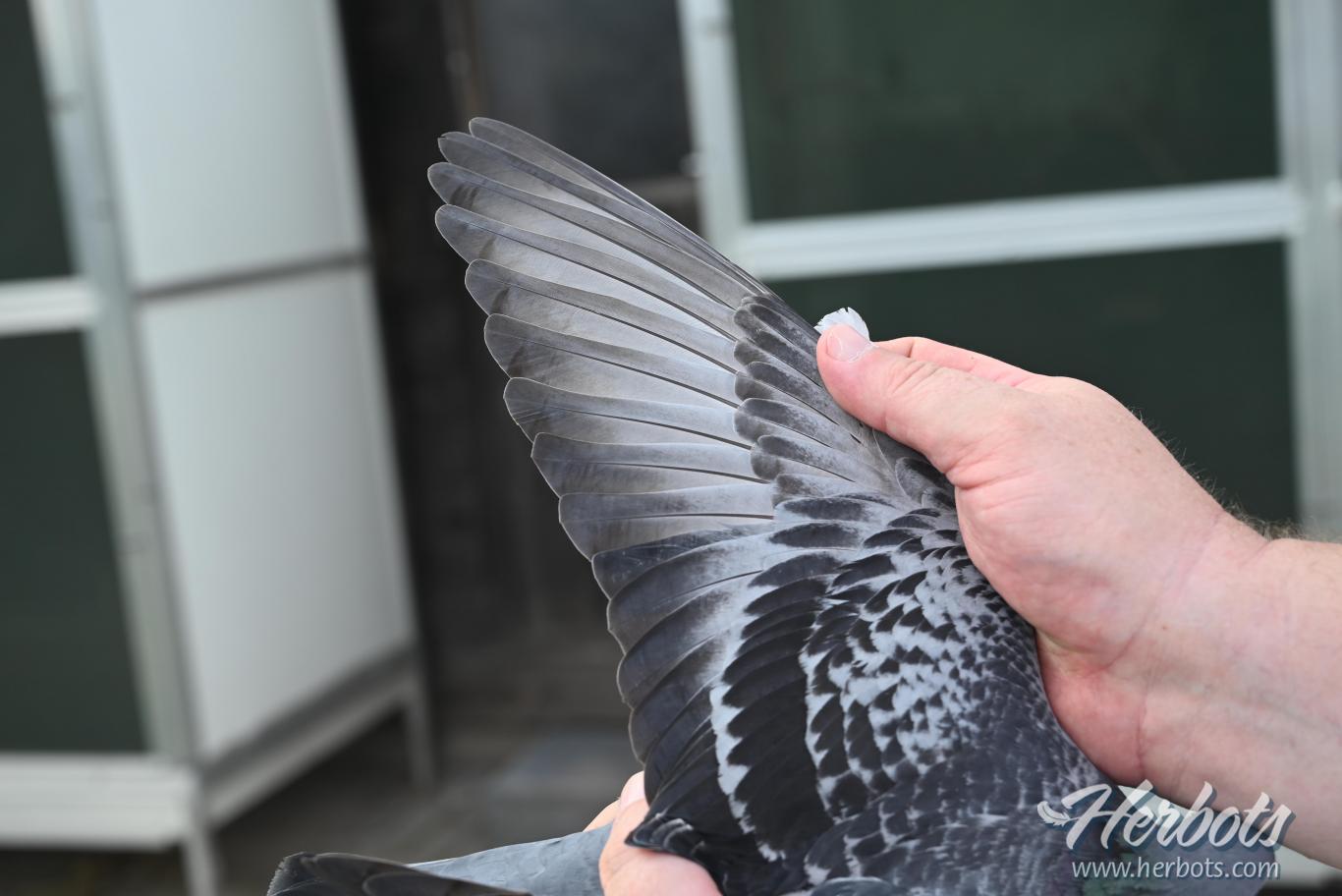
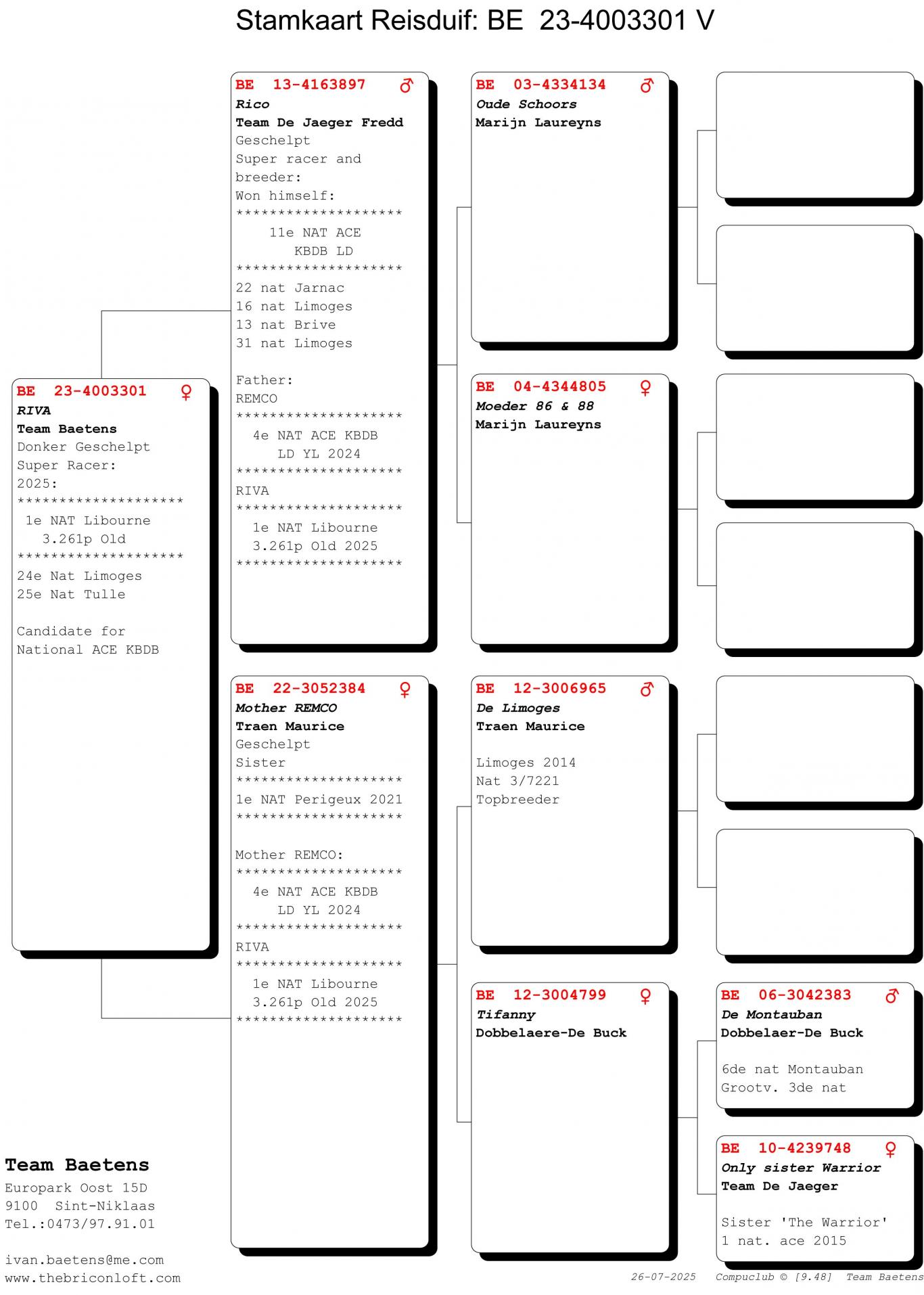
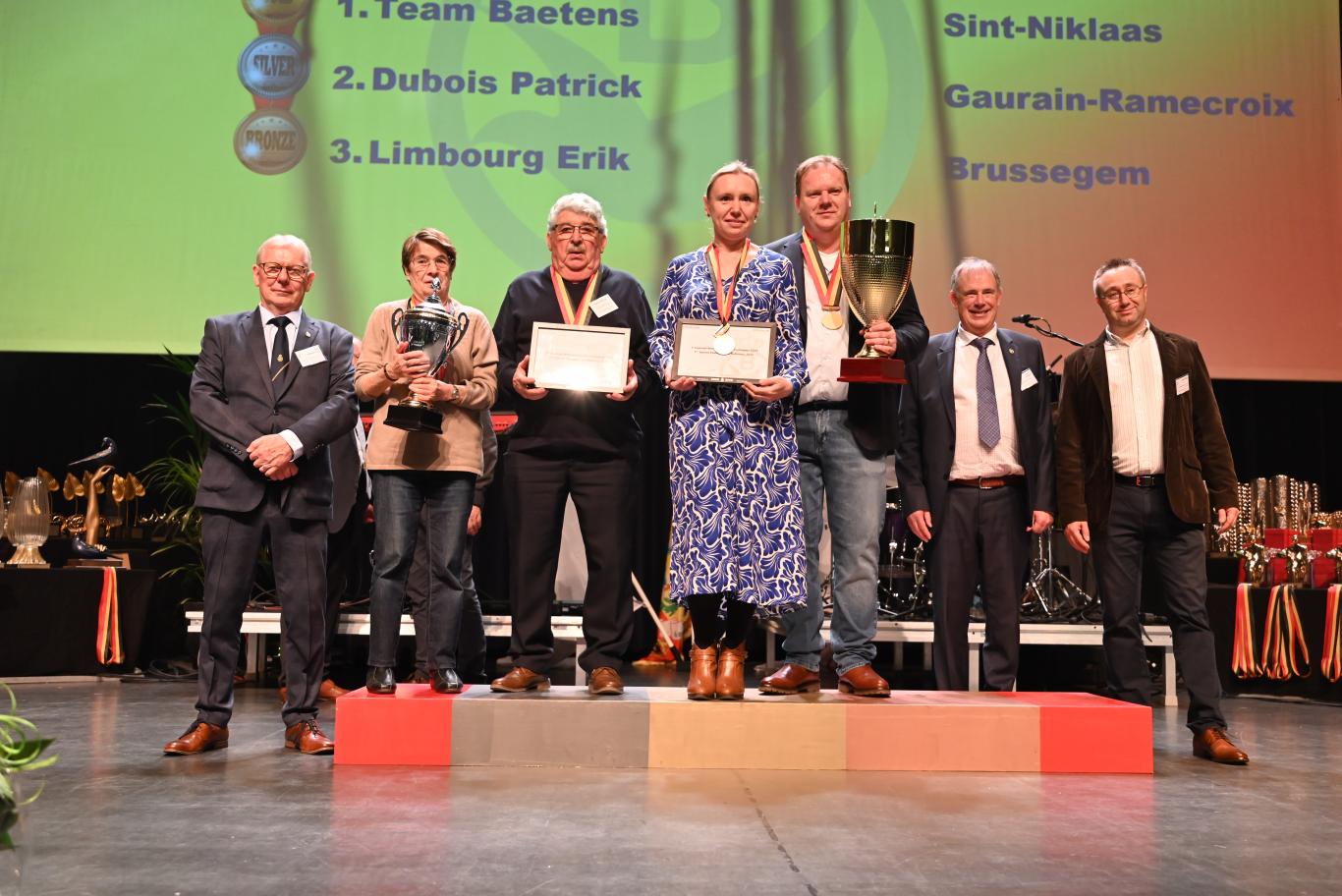
And Ivan and his team... they're reaping what they've sown all these years. All that effort, all that investment, all that motivation… it didn't end in that one "crazy" weekend of July 26th. When the various championships were announced during the winter period, they could pop the champagne bottles again. Enjoy:
Top results 2025 season:
1st Belgian Olympiad Pigeon Category B - Middle Distance
1st Belgian Olympiad Bird Category I - Long Distance - 1 year
1st National Argenton Old Birds
1st National Argenton Yearlings
1st National Libourne Old Birds
1st National Ace Pigeon KBDB Long Distance Old Birds
1st World Best Pigeon - Best of the World!
2nd National Ace Pigeon KBDB great Middle Distance Old Birds
3rd National Ace Pigeon KBDB great Middle Distance Old Birds
3rd National Champion Long Distance Yearlings
4th National Champion Long Distance Old Birds
5th National Ace Pigeon KBDB great Middle Distance Yearlings
2nd General Champion KBDB East Flanders
Widowers
Ivan continues enthusiastically "At the beginning of December they were paired, simultaneously with the breeders, and you probably feel it coming, indeed the eggs of the breeders were underlaid with the cocks. For that reason, the widowers and their hens were exposed just like the breeders so that there was simultaneous laying in both groups. Only the best widowers are allowed to raise their own young. Once the youngsters were about 20 days old, both the youngsters and the hens were removed from the widower loft and the cocks moved to the adjacent aviary. Thanks to the wind netting, the cocks are protected day and night. During this period, they receive clean water and as feed 50% Gerry Plus I.C. and 50% purification. In mid-February, the widowers returned to their loft and were allowed to start their first training sessions around the loft. The menu was changed to 100% Gerry Plus I.C..
They were paired back on 11/03 and once the first pair had been breeding for 10 days, all hens were taken from the loft. On 18/03, they received a 6-day tricho treatment via water.
At the end of March, there was a parathyphoid treatment. This year they were vaccinated by vet Ruben Lanckriet with a combination vaccine. The other years they were vaccinated via drinking water. We changed methods because we want to create a boost in (basic) condition. Against ornithosis, vaccination is never done before the start of the season, unless the vet judges otherwise. It so happens that vet Lanckriet will come for a check-up every 2-3 weeks during the season and if he does find something wrong then treatment will be done in consultation.
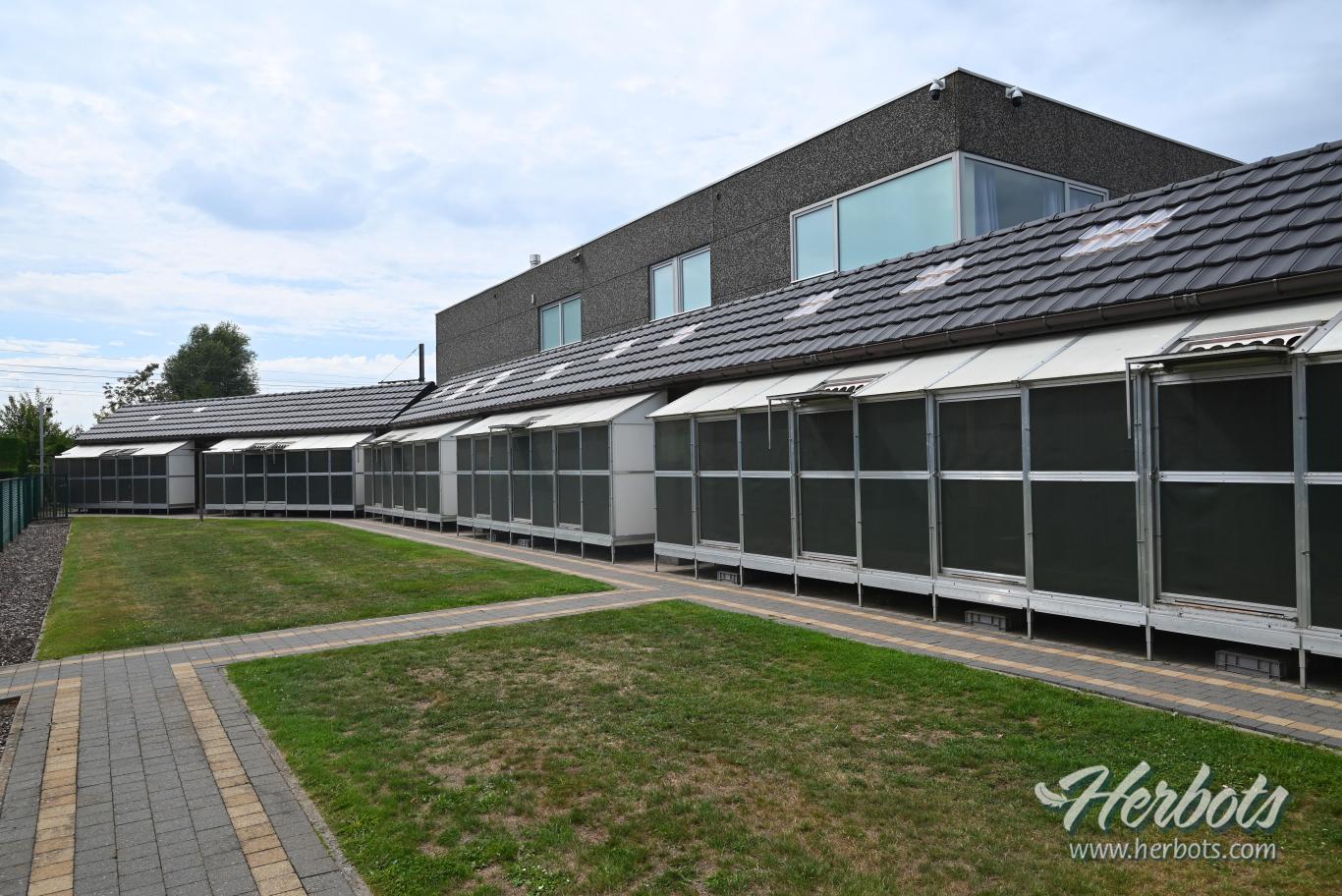
The old and the yearling widowers are on 1 long loft with 4 sections. The widowers are not darkened before the season. I think it is breed-related, but with us it is no exception that our cocks are still on 8 pens in August. In good weather, the first learning flights take place. Via Quievrain (90km) it goes via 3 x Noyon (195km) towards middle distance. The 2nd weekend of May a provincial Orleans flight is scheduled and on this flight they will go anyway. Afterwards, the troops will be divided and each will fly its own programme. For the old widowers that is day long distance and for the yearling widowers large middle distance combined with long distance."
Widowers during the season
Upon returning home, recovery is immediately addressed. On Saturday, they are given a "recovery pill" and protein is added to their feed. Various sugars and BS (Belgica-de Weerd) are added to their drinking water. The first feeding after returning home is a full bowl of Champion Plus IC + Energy Plus IC.
On Sunday, the first feeding again consists of Champion Plus IC + Energy Plus IC + protein, and the second feeding is ½ Champion Plus IC and ½ Gerry Plus IC.
Starting Monday, the diet is 100% Gerry Plus IC. Only the last five feedings are 100% Champion Plus IC + Energy Plus IC. This mixture is enriched with peanuts.
The widowers train twice a day and are fed twice a day. Both feeding and drinking are shared. Before basketing, the partner is briefly introduced.
Hens
Ivan continues unperturbed: "The old and yearling hens are prepared for the season in various ways. The 16 best hens are paired against our best breeders (bull method) at the beginning of December and lay twice. These eggs are always shifted among other couples.
A 2nd group is paired on different dates and their eggs are replaced with the breeders' eggs. By acting this way, we quickly have several rounds of our breeders.
On 11/03, all hens are then paired back with their partners and allowed to breed again for a few days. So our best hens have already laid 3 times before the start of the season. Experience has taught us that this has no influence on the condition during the season.
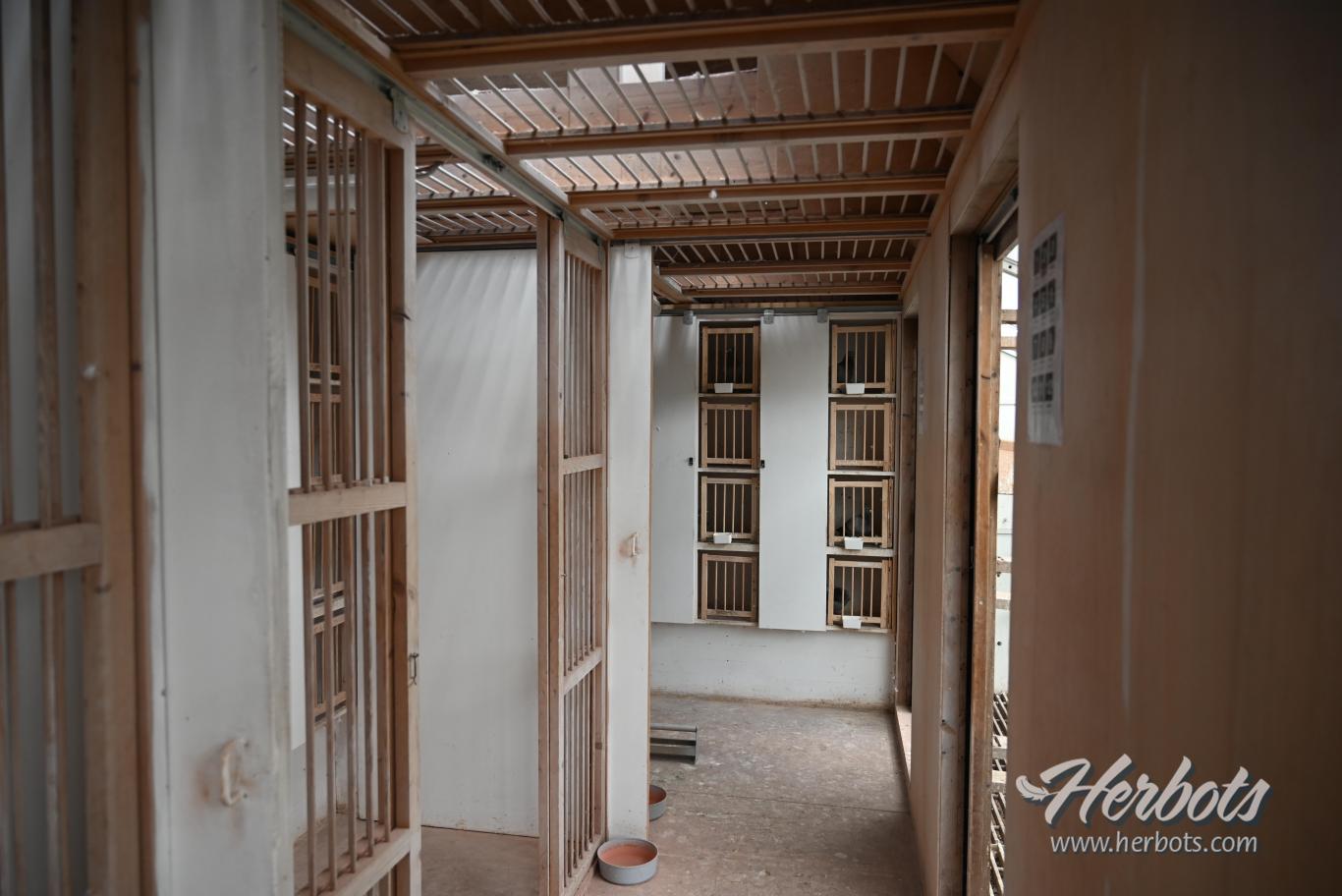
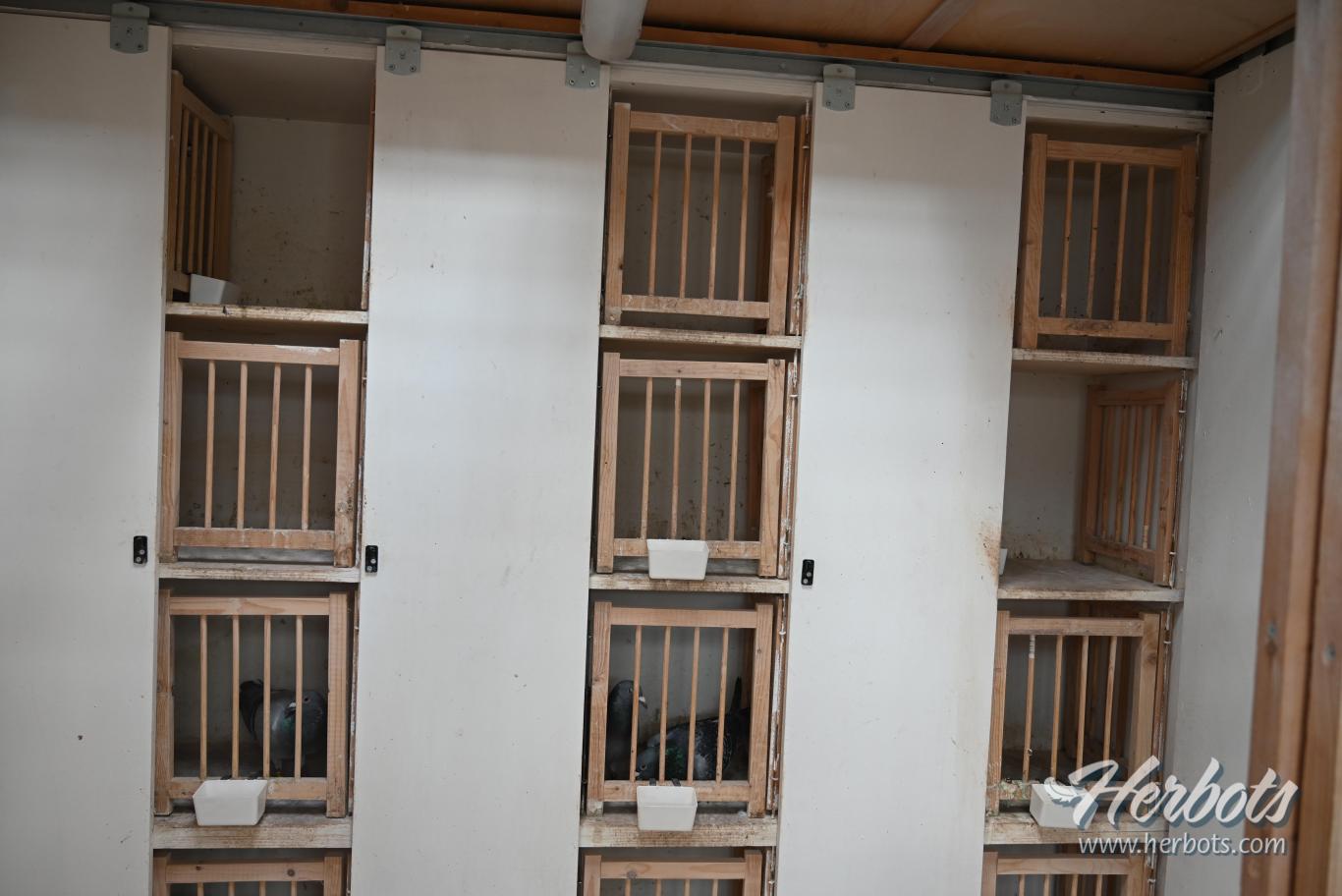
Unlike the cocks, the hens are darkened and this during the first 2 weeks of April. Two weeks of darkening, whether this really makes such a difference? Well yes... you should know that we play our hens on widowhood until mid-August and then those 2 weeks of darkening really prove their worth. The hens fly the heavy middle-distance and long-distance flights. Like the widowers, the ladies train twice a day and are fed twice a day. During the day, they live in special small living boxes (see photos). After their training, they are first allowed to eat and pick up some fresh grit and then they are confined to their living boxes where they can drink. The hens are divided over 4 lofts. Those are 2 lofts to the left of the 4 widowers' departments and 2 to the right of them.
In terms of feed, by-products and medical supervision, this is the same working pattern as for the widowers. When the hens are fed, we always watch the eagerness with which they eat. When this decreases, the table is usually cleared.
When basketing, the hens get their cock for 30 minutes. Only for speed races the cock is half-baked. For the other races, they can do as they please. After the race, they stay together for about 2 hours.
Both our widowers and our hens train on the day of basketing and if they don't feel like training, we even dare to rake them at 80 km. Good training stimulates the appetite and that is important."
Geraardsbergen
On Wednesdays, all racing pigeons are trained from Geraardsbergen (47km). The pigeons are released in three groups. First, a group of hens is released, followed 5 minutes later by a second group of hens, and 10 minutes later by the widowers. If the cocks are really in shape, all three groups will reach the same speed. Thanks to the Bricon system, we can record this perfectly. The Wednesday before my famous WE, the first group reached a speed of 1,760 m/m, and believe it or not, the speed of the second and third groups was the same. And the way they dove towards the landing board still gives me goosebumps.
When you see that, you'll definitely sleep soundly.
You only have to ask yourself questions when a few pigeons arrive later. Why aren't they among the first pigeons? Why did they leave the group? Have they not yet recovered from the previous flight? Do they really need to be basketed?
Young pigeons
By laying the breeders' eggs frequently and working with eight "bulls," we quickly have about 200 youngsters. These are divided into two groups. The goal of the young pigeon racing is to gain experience, and I personally think it's a good thing that several national races for young pigeons are scheduled. We can easily skip a national young pigeon race if the weather isn't favorable. Usually, only hens are entered for the first national young pigeon race from Bourges. I might be mistaken, but I have the impression that young hens are less likely to be swept along by the crowd. We are especially cautious when the wind is westerly. This is less important for the other national races.
Of course, we darken the youngsters, starting March 15th and ending on the longest day of the year. After that, they are lighted until the end of the season. We only do this with the first round. The second round is no longer darkened. They can be trained well, but that doesn't mean they fly a national race.
The first Two to three weeks after weaning, they are fed 100% breeding mixture, after which Junior Plus IC is added to the diet. This mixture is provided until the first flights. If the youngsters aren't flying to our liking, we can lighten the diet with 15% Gerry Plus IC. The youngsters, like the old birds and yearlings, are fed twice a day.
To avoid putting all our eggs in one basket, the youngsters are trained in two groups. Weather permitting, we travel with them. Personally, I believe you can never train a young pigeon too much, and if they have a tough training flight where the youngsters come home in pieces, I consider that a plus. Losses must, of course, remain acceptable, otherwise there's a health issue.
Once a group has completed a 200km flight, the sexes are separated, and the youngsters are raced on the sliding door system for the remainder of the season.
As mentioned, during the season, we often travel to the "Muur" (Wall) of Geraardsbergen. This is 47km for us. When the youngsters return from this training flight, the sexes are allowed to party for an hour, after which they are inevitably separated again.
On the day of basketing, they come together for two hours. We do this fairly early in the afternoon because, to ensure the youngsters eat well, we separate them again and give them another generous feed. This way, they go into the basket with a well-filled crop.
During the season, we copy the care system of the old and yearling pigeons.
The base
If we analyse the base of the Baetens colony we see that there are 3 breeding lines.
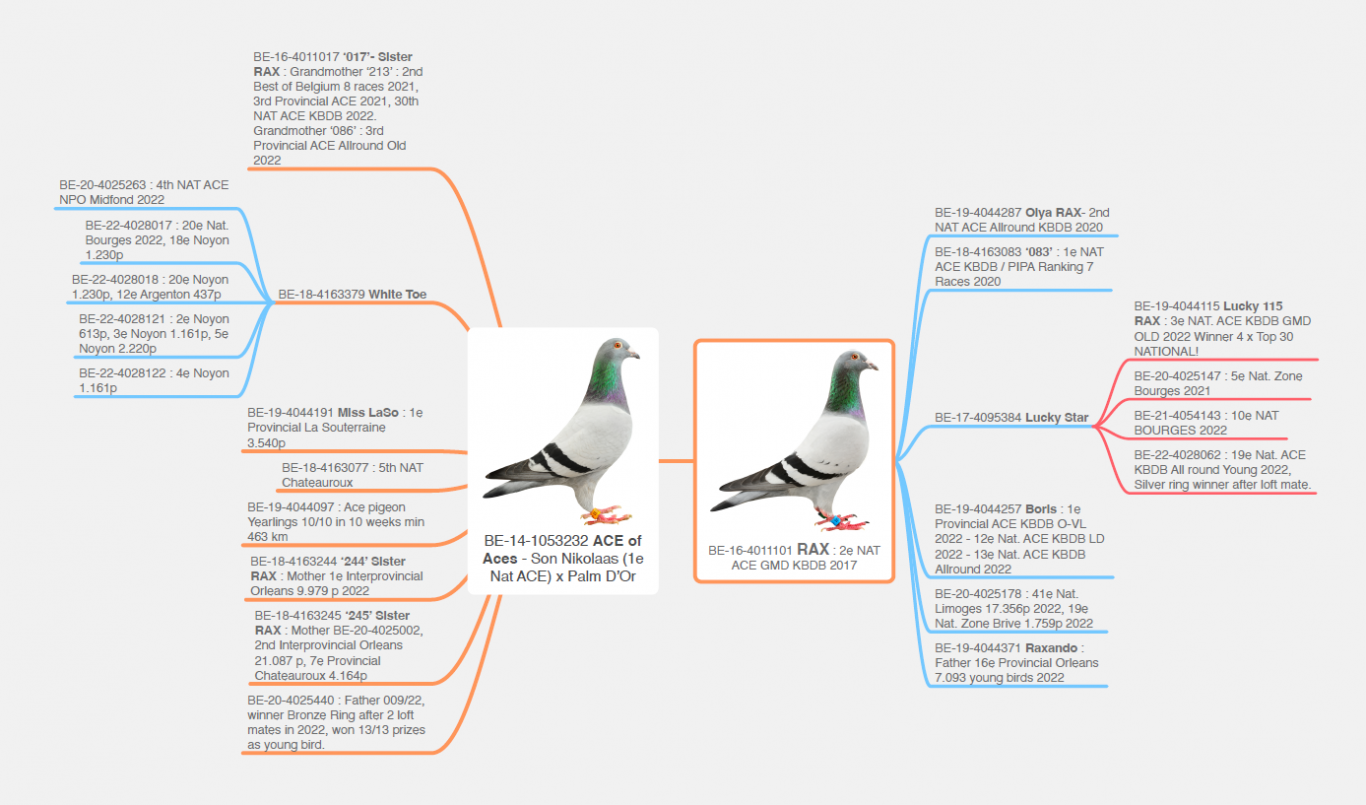
1st base line is a pigeon from Casaert-Sénéchal (son of 1st National ace KBDB "Nicolaas" x his mother "Palme d'Or" - also mother of 1st Nat. ace KBDB "Amalia") coupled with a pigeon from Staf Vermeiren which won 7th National ace KBDB ½ Fond.
Tribal bear “Rax” in particular is the common thread running through the Baetens colony.
“Rax” B16-4011101 won
2nd Nat. ace KBDB middle distance yearling
2nd World Best Pigeon Distance
1st and 3rd Olympiad pigeon 2019-2020
12th and 13th National ace pigeon KBDB 2022
14th and 15th National ace pigeon KBDB 2020
14e en 15e Nationale asduif KBDB 2020
"RAX" is the sire of:
1st Nat. Argenton 5,812 p.
2nd, 4th, 5th, 12th, 13th, 14th, and 15th National KBDB Ace Pigeon winners
2nd and 3rd World Best Pigeon winners
"RAX" is the grandfather of:
3 x 1st National winner
1st World Best Pigeon (Best of the World!)
1st and 3rd Olympiad Pigeon KBDB
2nd, 3rd, 3rd, 12th, 16th, 18th, 19th, and 25th National KBDB Ace Pigeon winners
Talk about a valuable breeder!

The second base line is the "Gladiator line" from Bart Geerinckx (Wommelgem). These were brought to St. Niklaas in both 2005 and 2010.
The third base line is a joint breeding with pigeons from Bart and Nance Van Oeckel (Oud-Turnhout). The line from his famous "F-16" has been particularly successful. This line was crossed with the previous two base lines, and it's proven to be a great success.
My pigeons perform well up to 750km, but since we want to achieve higher results, we're always looking for reinforcements. For example, we purchased a superior hen, "Wonder Moeder," from Maurice Traen.
After our conversation, we can only conclude that we haven't seen the very last of the Baetens colony. The present class spiced with the motivation of owner Ivan will lead this colony to many great performances.
Stefan Mertens
Especially for Pigeon Bids, Ivan selected 11 youngsters born from his best breeders
This internet auction ends Thursday 26 February at 2 p.m. (c.e.t.)