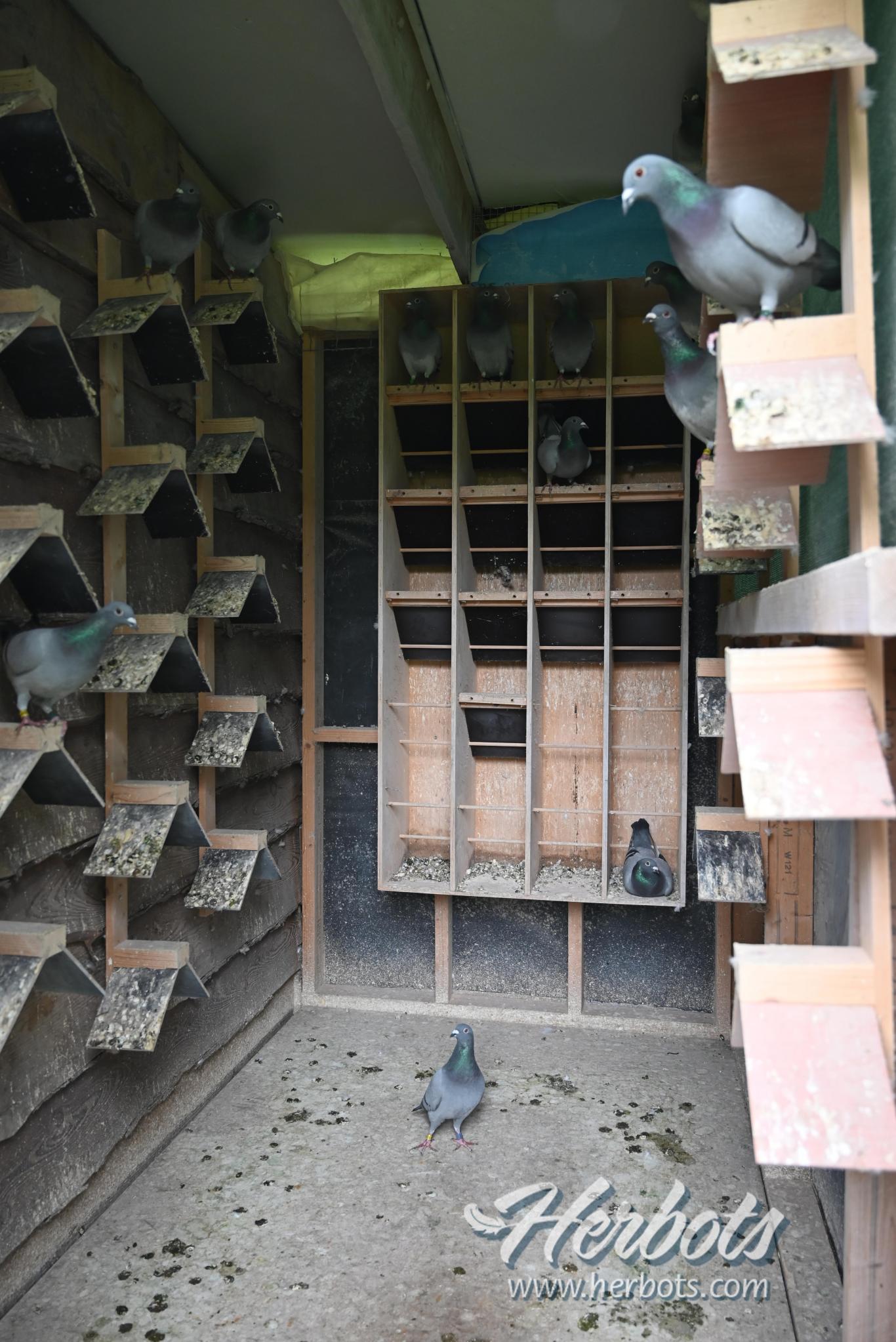
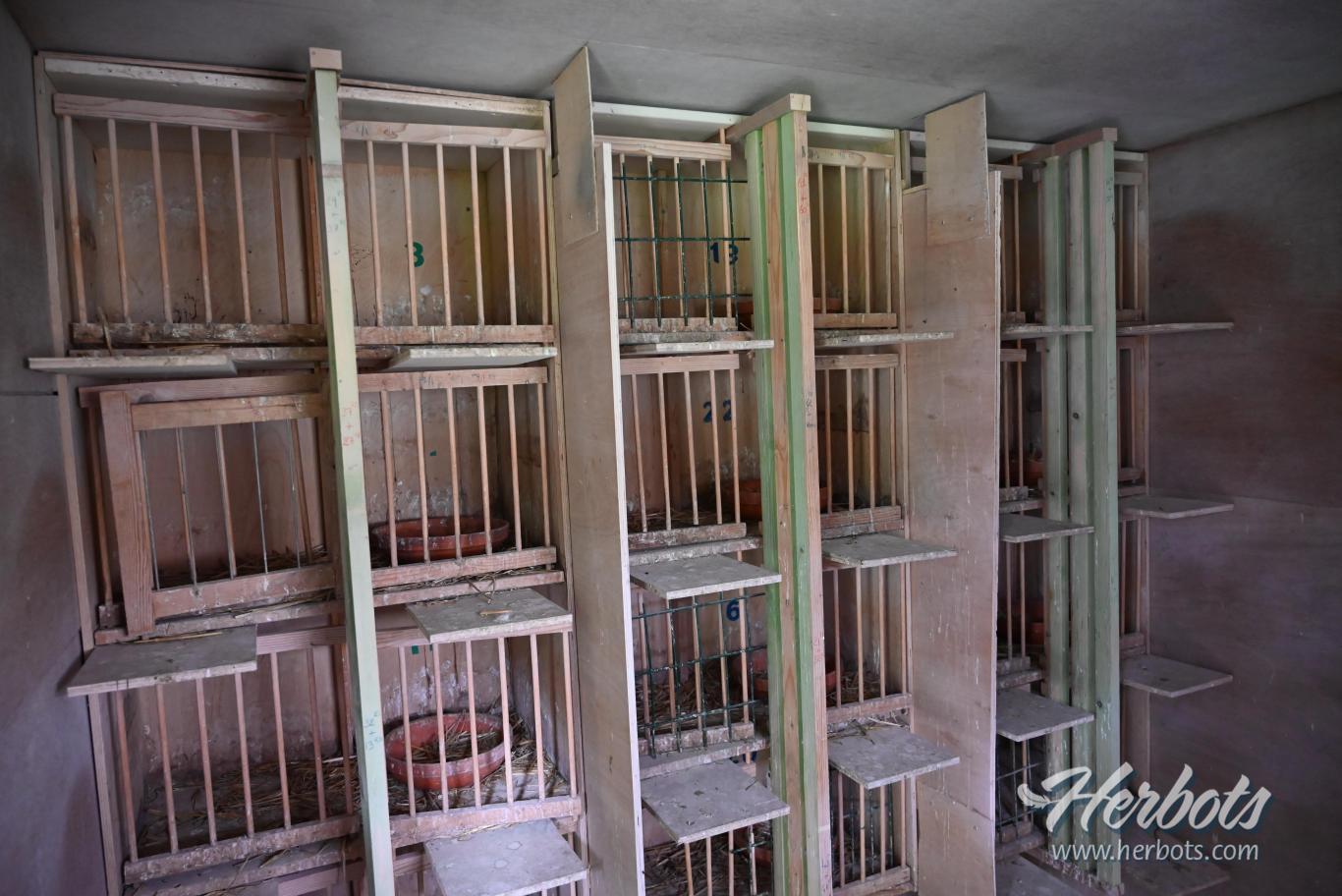
Tom Van den Berghe (Meerbeke) wins 3 x 1st Provincial in just 4 weeks
11 Aug 2026
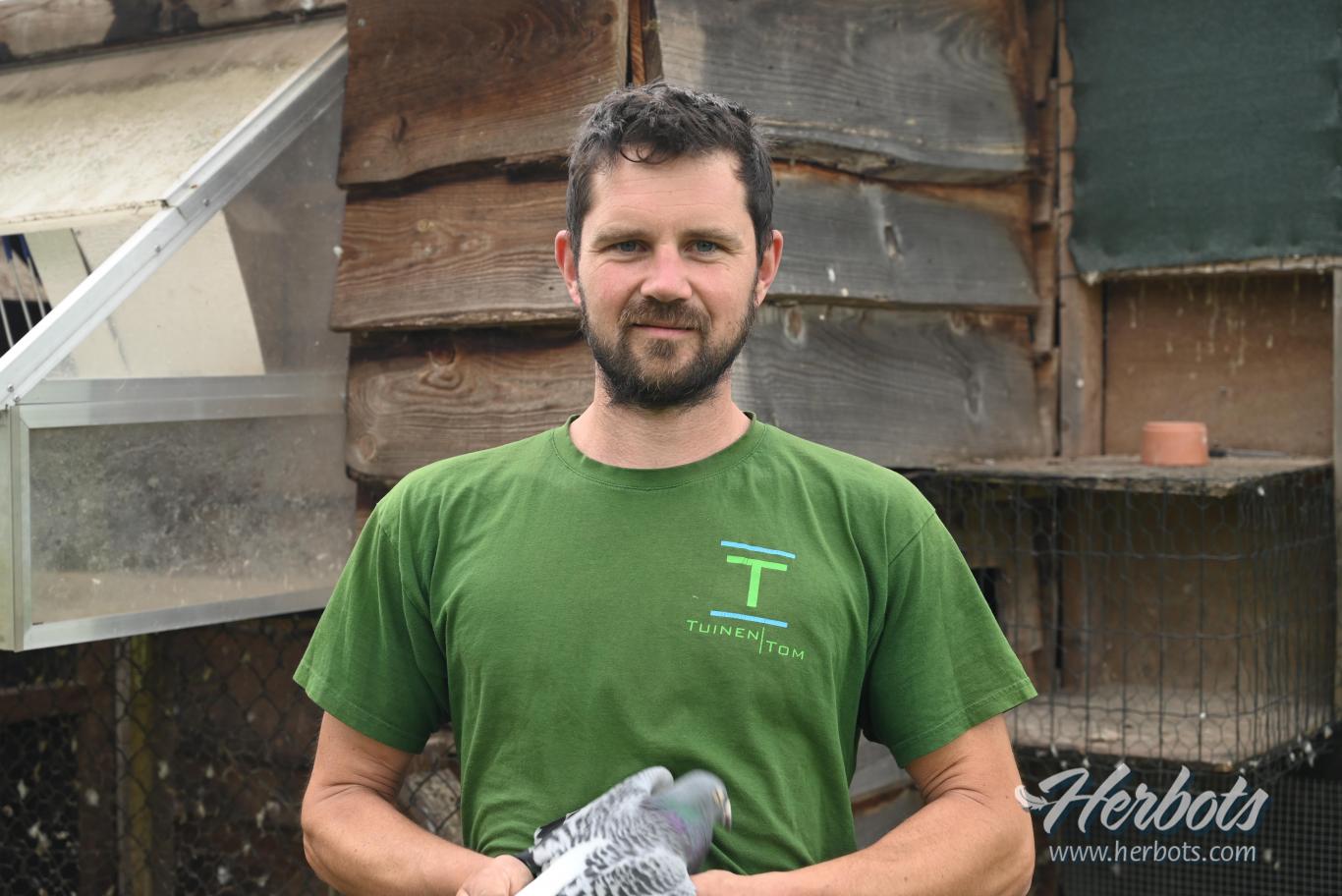
Meerbeke… a borough of Ninove and, indeed… Meerbeke was the finish location of the renowned cycling classic Tour of Flanders for 39 consecutive years. The first time was in 1973, with Eric Leman taking the victory, and the last time was in 2011, when Nick Nuyens triumphed. 39 editions featuring a long list of legendary cycling heroes among the winners.
In the world of pigeon racing, Meerbeke is home to Tom Van den Berghe, a fancier who is also increasingly making a name for himself with his performances. For several years now, he has been the man to beat in the Dender region. Fanciers know that Tom is no stranger to producing a top-class result, but the outstanding performances achieved by the Van den Berghe colony in recent weeks can only be spoken of with great admiration. In the space of just four weeks, three provincial victories were achieved, including 1st and 2nd Provincial on two occasions! In the Bourges National, they did it again… 1st and 2nd Provincial, as well as the two fastest pigeons of 7,602 Bourges racers in East Flanders! Results to cherish.
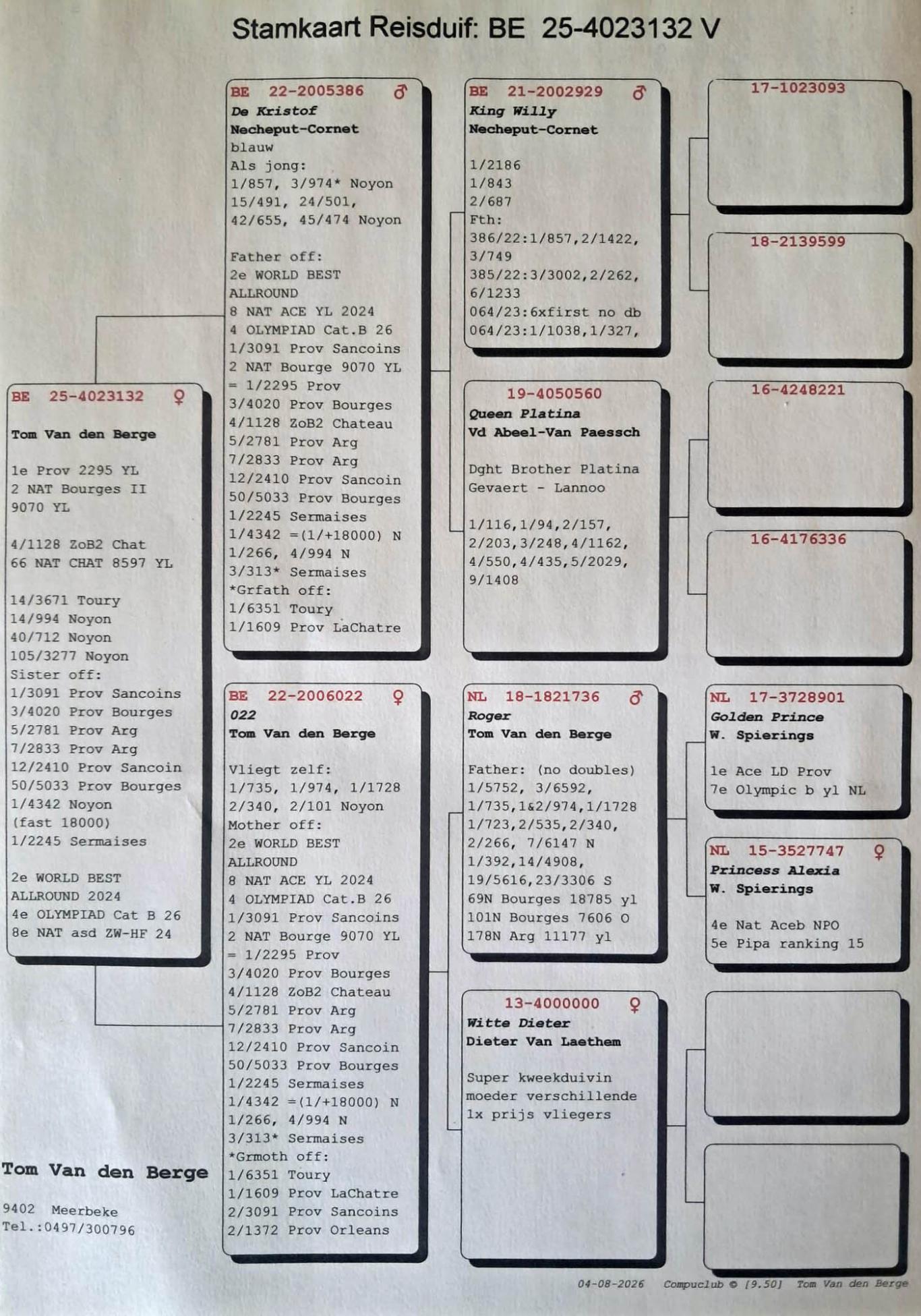
Two foundation pigeons
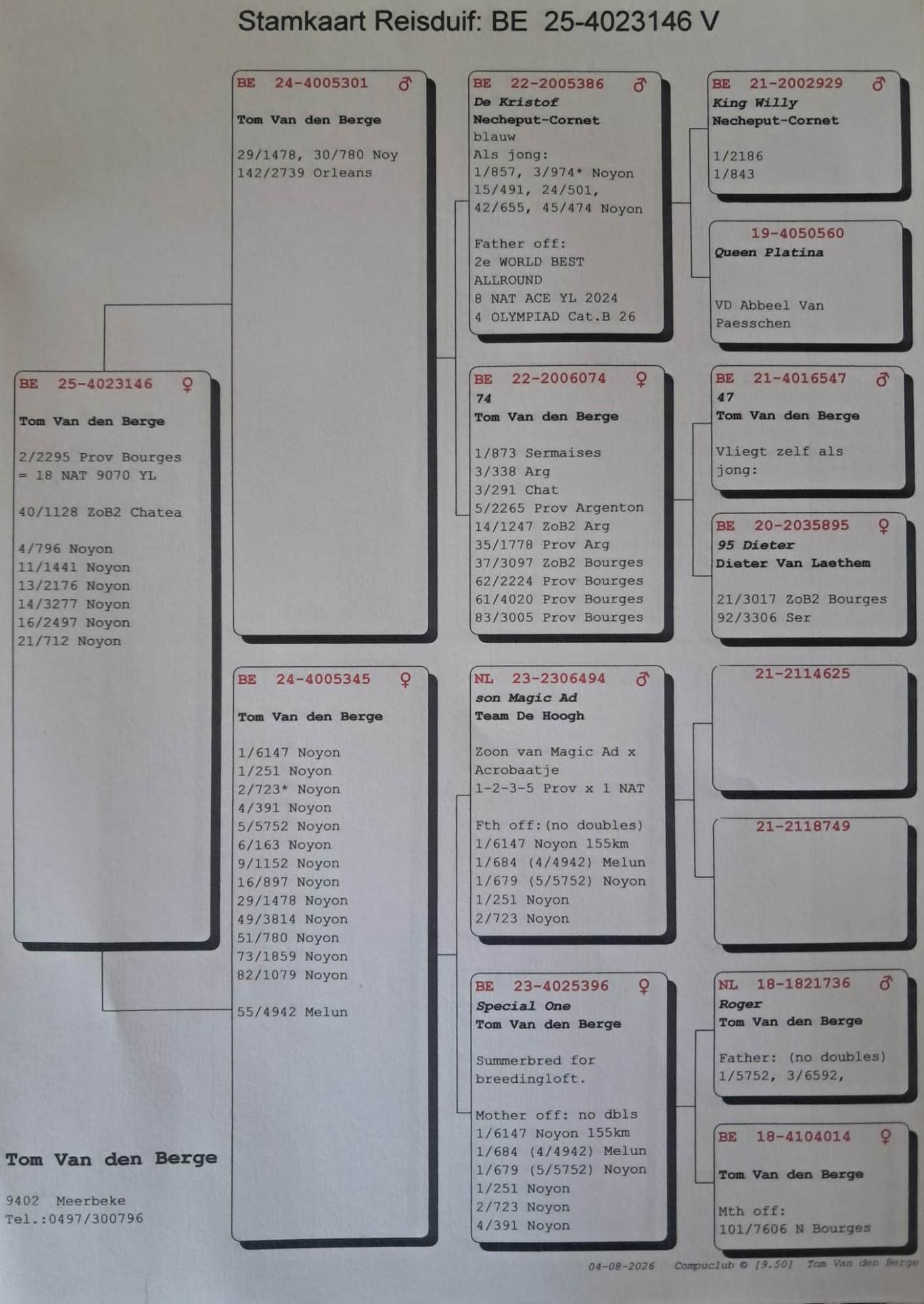
Tom: “My very best breeder is without a doubt ‘De Roger’ - NL18-1821736 (original Wout Spierings). He was named after my grandfather, from whom I inherited my passion for pigeons. Almost 80% of all my racing hens are grandchildren of ‘De Roger’.
Then there is ‘De Kristof’ (B22-2005386 – original Nechelput-Cornet). He is the sire of 1st Provincial Sancoins and 1st Provincial Bourges. He is also the grandsire of 1st Provincial La Châtre and 2nd Provincial Bourges.”
Racing hens only
Tom (born in 1987) is a self-employed landscape gardener, which means there is not much spare time. His working day starts early and he does not mind putting in an extra hour. But everyone needs some relaxation as well, and Tom finds his in our beloved pigeon sport. Those who know Tom know that he never does things by halves, which is why he chose to concentrate exclusively on racing hens. There are no widowhood cocks here, while the youngsters are simply trained and educated very well. A few sprint races and, if possible, a few middle-distance races are the only experience they gain during their first year of life.
Tom started the 2026 season with a team of 35 hens (old birds and yearlings). For this group of hens, Tom has 17 cocks. Some of the hens are paired early and are allowed to raise a pair of youngsters, while the others do not see a cock at all during the spring.
The first time this second group of hens sees a cock is during the first training tosses. For them, it is a matter of finding their partner. The cock is confined to a box, with two small shelves separated from each other in front of it. The fact that the hens in this second group are still searching and may be here today and somewhere else tomorrow provides extra motivation for the hens that have bred. On the other hand, when one of the hens from the second group does find the love of her life, this once again provides an additional motivational boost.
“My hens train at 6 a.m.,” Tom begins. “So far, they have easily been training for one hour or even 1 hour and 20 minutes, entirely of their own accord. I really do not need a flag to keep them in the air. When you see this kind of training behaviour as a fancier, you can always go to bed with peace of mind. In the evening, at around 6 p.m., a second training session is scheduled. The hens are therefore also fed twice a day. I use Beyers mixtures (Vandenabeele, Sport Light and Galaxy Energy), as well as all of Beyers’ supplementary products. In fact, it is very easy to explain… just take the Beyers promotional brochure and you have my system. I literally copy and paste it.
The racing hens are taken for a 27 km training toss once a week. One week I drive them myself, and the next week my friend Dieter Van Laethem does it. The cocks are then confined to their boxes and, when the hens return home, they are allowed to admire their cock from behind the bars for about 15 minutes. On basketing day, they no longer see a cock and are taken straight from the loft. When the hens return from a national race, they are allowed to spend around 15 minutes half-box with their cock before being moved back to the hens’ section. The following day, once they have recovered well, they are allowed to spend a full hour cuddling with their cock. This is done in turns so that every hen has her cock entirely to herself for a full hour.
Tom, on behalf of the entire Herbots team, congratulations on this fantastic season, and we wish you continued success!
Stefan Mertens